18/08/2026 21:14pm

Claude Opus 5 Features & API for Devs
#Claude Opus 5
#Claude API
#Anthropic
#Agentic AI
#AI for developers
#AI Coding
For Devs who are immersed in code every day, a universal problem when choosing an AI assistant is, "Top-tier models are brilliantly smart but the API costs will bleed you dry, while budget-friendly small models often drown in shallow water when facing complex tasks," right?
If you are looking for a middle ground, we have good news today! On July 24, 2026, Anthropic dropped a bombshell by launching Claude Opus 5, a new model designed to be the "Default Model" for everyday use. The exciting part about Opus 5 is that it packs Frontier-level intelligence, breathing down the neck of its older sibling, Claude Fable 5, but comes at a 50% cheaper price. Most importantly, you pay the exact same price compared to the Opus 4.8 model.
In this article, we will take everyone to dissect the capabilities of Claude Opus 5 to see just how awesome it is, especially the new updates that Devs can immediately build upon for Agentic AI or to help debug code. Let's dive in!
Elevating Coding & Debugging (State-of-the-Art)
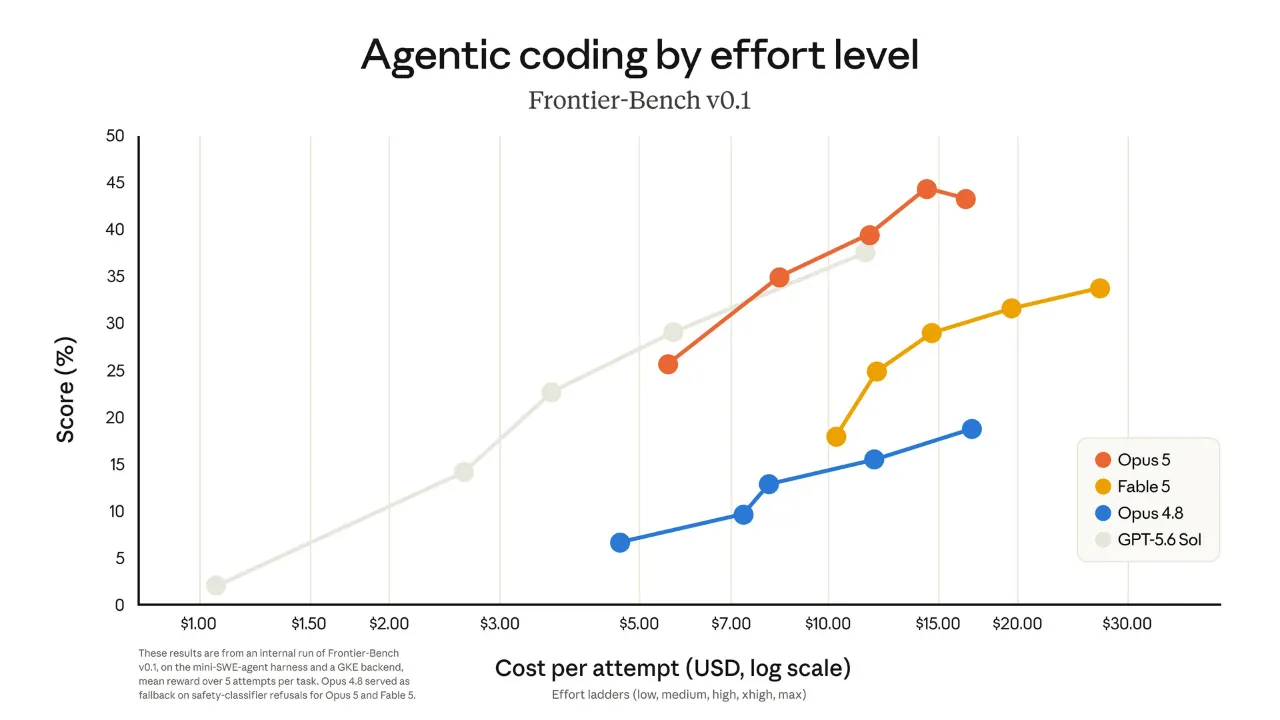
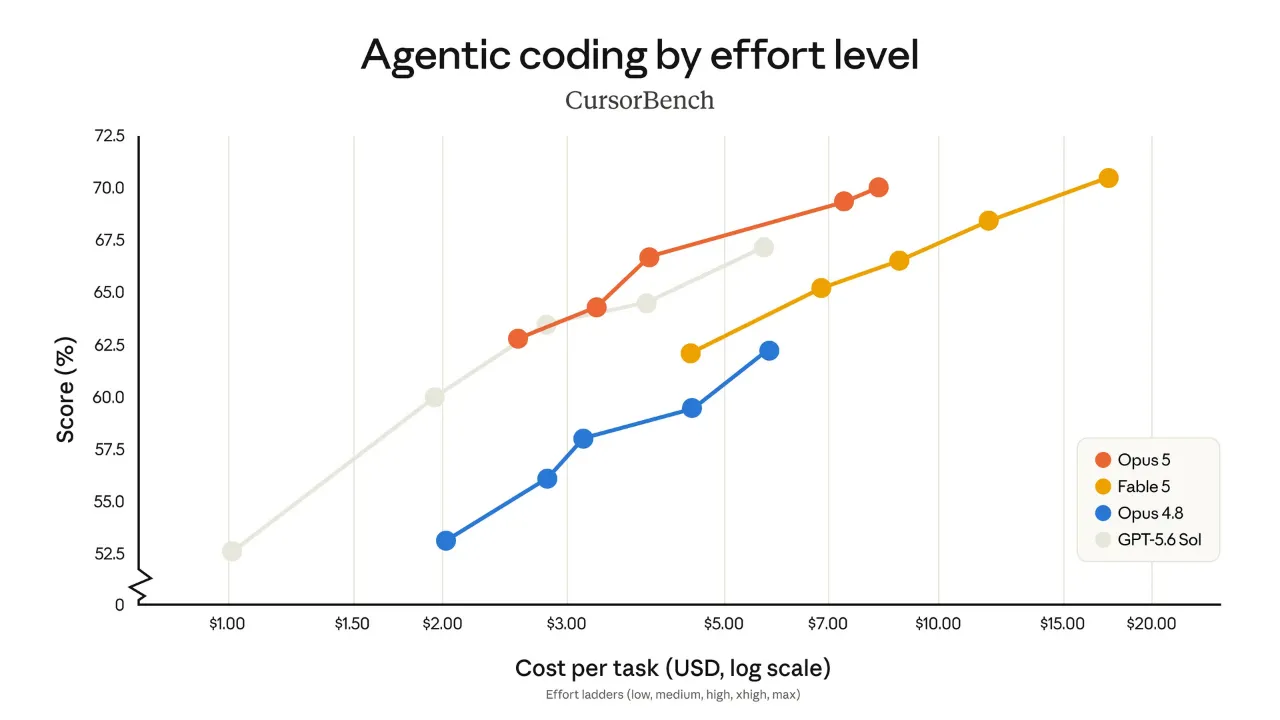
Source: Anthropic
For Devs, code that runs perfectly on the first try might be rare, but an AI that helps debug problems by "pulling them out by the roots" is even rarer! Claude Opus 5 takes coding and code review to the next level, ranking State-of-the-Art on Frontier-Bench v0.1 and scoring on CursorBench 3.2 nearly neck-and-neck with Fable 5 with a difference of less than 0.5%, but at only half the cost.
Here are the exciting highlights:
Fixing issues at the Root Cause, not just the symptoms: In a real-world debugging test of a popular Open-Source Package Manager, other models often just applied band-aid fixes based on the symptoms. However, Opus 5 successfully traced the issue down to its root cause and covered edge cases that the human team had overlooked.
Self-Correction as if a Frontend Dev is watching over: Opus 5 has the ability to open a browser to view the UI on both Desktop and Mobile screens. It scans for problematic spots, such as a Checkout button falling off the screen or products hidden below the fold, and automatically fixes the code itself before handing over the work.
Example: There was a test to build a 3D FreeCAD model from a drawing of a machine part, intentionally without feeding the image directly to the AI. The result? Opus 5 wrote its own Computer Vision pipeline to extract the pixels and successfully generated the 3D model, something no competing model could achieve even after 5 attempts!
Smart and Agentic: Thinks, Acts, and Verifies on its Own
If anyone is secretly working on Agentic AI or Automation Workflows, let me tell you that Opus 5 will become your new secret weapon. It has been trained to smoothly handle highly complex and lengthy multi-step tasks.
ARC-AGI 3 (Solving novel problems): Scored three times higher than the second-place model.
Zapier AutomationBench: Testing end-to-end business operations (like checking customer account health, screening for churn risks, and sending alerts). Opus 5 achieved a 100% success rate, whereas previous models failed this test entirely.
OSWorld 2.0 (Computer use): Surpassed Fable 5's score at just over a third of the cost.
Creating Interactive Visuals (Visual & Vision)
Beyond just handling text or code, Opus 5 has upgraded its Visual Processing and Artifact creation capabilities to the next level.
The model can understand the dimensions of an image and write code to natively render complex, interactive visual outputs. For instance, simulating a Wind Tunnel to observe airflow over objects, or generating a responsive biological cell diagram. This makes creating UIs, Web Animations, or 3D Components for the web significantly easier.
Safest and Most Highly Aligned (Safety & Alignment)
From an enterprise perspective, safety and reliability are at the core. Anthropic states that Opus 5 adheres to Claude's Constitution better than any model before it.
Lowest Rate of Deceptive Behavior: It has a misaligned behavior score of only 2.3, which is the lowest across the entire model family.
Cybersecurity Safeguards: It possesses Vulnerability Identification capabilities on source code that rival dark-side models like Mythos 5, but is strictly locked from Exploit Generation. This makes it highly suitable and safe for internal team Code Reviews.
API Updates Developers Need to Know
For Devs who are itching to connect Opus 5 to an API for projects or embed it into applications, here are the essential updates you need to know:
Same price, unbelievable value: Priced at $5 per 1 million Input Tokens and $25 per 1 million Output Tokens (the exact same price as Opus 4.8), but you get intelligence nearly on par with top-tier models.
Rocket-speed Fast Mode: If your project is highly sensitive to latency, Anthropic offers a Fast mode that accelerates output generation by 2.5 times, in exchange for double the API cost.
Mid-conversation tool changes (Beta): This feature is incredible for those building Agentic Workflows! You can now "change the toolset (Tools)" in the middle of a conversation without the system clearing the Prompt Cache. This saves a massive amount of time and Token costs.
Automatic Fallbacks (Beta): An automatic error handling system. If a sent prompt hits Opus 5’s Safety constraints (Guardrails), the system can be configured to seamlessly switch to another model, like Opus 4.8. This ensures your API calls remain smooth and your app doesn't crash mid-way.
Top 5 FAQs Before Deciding to Switch to Opus 5
Is Claude Opus 5 more expensive than the previous version?
Not at all! The price is exactly the same as the Opus 4.8 model. You get to use a Frontier-level intelligent model at an incredibly cost-effective price. This reinforces Anthropic's intention for this to be the Default Model accessible to everyone.
What kind of projects is this model best suited for?
It is highly suitable for API integrations to build AI Agents that require multi-step sequential tasks (Agentic Workflows), deep root-cause code writing or bug scanning, and business data analysis that demands high accuracy.
Is the Fast Mode feature on the API worth paying for?
Yes, it is worth it. If your project is an application that requires real-time user interaction, or where User Experience (UX) is a matter of life-and-death. Paying double for 2.5x the speed will excellently reduce user frustration.
How does Opus 5 differ from top-tier models like Fable 5 and Mythos 5?
Opus 5 primarily focuses on "cost-effectiveness and all-around utility." However, for highly specialized or dangerous tasks, such as deep biological research or advanced cyber exploitation, top-tier models like Mythos 5 are fine-tuned to handle those specific fields much more deeply.
What is the benefit of the Automatic Fallbacks feature when connecting to the API?
Normally, when a user types a prompt that borders on violating Safety rules, the API blocks that command immediately, causing the app to throw an error. But this feature seamlessly and temporarily switches to another model, significantly reducing the developer's burden of writing error-handling code.
Conclusion
Claude Opus 5 marks a significant milestone for Anthropic, perfectly balancing "top-tier intelligence" with "an affordable price" right now. Whether you are a Dev looking for an assistant to debug complex code, or an Engineering team seeking a model to run Agentic Workflows for the enterprise, Opus 5 is a choice ready to impressively get the job done for you. Anyone interested can try it out today at Claude.ai or via the Claude API.
And what about the Superdev Academy community? After reading this, do you have any ideas for connecting Claude Opus 5 to an API to build a bot or start a new project? Drop a comment below to share your ideas!