18/08/2026 21:16pm

Is Clean Code Dying? Redefining Software Architecture in the Era of AI Agents
#Clean Code
#AI Native
#AI Agent
#Context Efficiency
#Superdev Academy
#AI Optimized Coding
#Software Architecture
Nowadays AI Agents no longer function merely as code autocompletion assistants; they have begun to play a core role in the software development lifecycle right from the project's inception. Technological statistics indicate that the codebases of many modern production systems are now primarily maintained and refactored through AI tools.
The traditional mindset of software developers has always been to write code that prioritizes human readability, ensuring that the work can be easily modified later. However, at a time when the primary entities processing and modifying code alongside humans are Large Language Models (LLMs) which possess massive context windows and the capability to analyze thousands of lines of code in a matter of seconds the very definition and goals of Clean Code are being called into question.
The necessity of splitting code into hyper-granular files or strictly adhering to legacy Clean Code rules may need to be re-evaluated to align with the operational behaviors of AI.
The Impact of Over Engineering on AI Agent Processing
Creating overly complex abstractions and breaking functions down into the smallest possible units (small functions) are methods designed to reduce the cognitive load on the human brain. However, this exact architecture is now impacting AI efficiency.
File hopping forces the AI into a state of continuous context switching, which results in unnecessary token consumption and increases the likelihood that the model will lose track of critical context that ought to reside together within that module.
Codebase Management Philosophy: Traditionalist vs AI Native
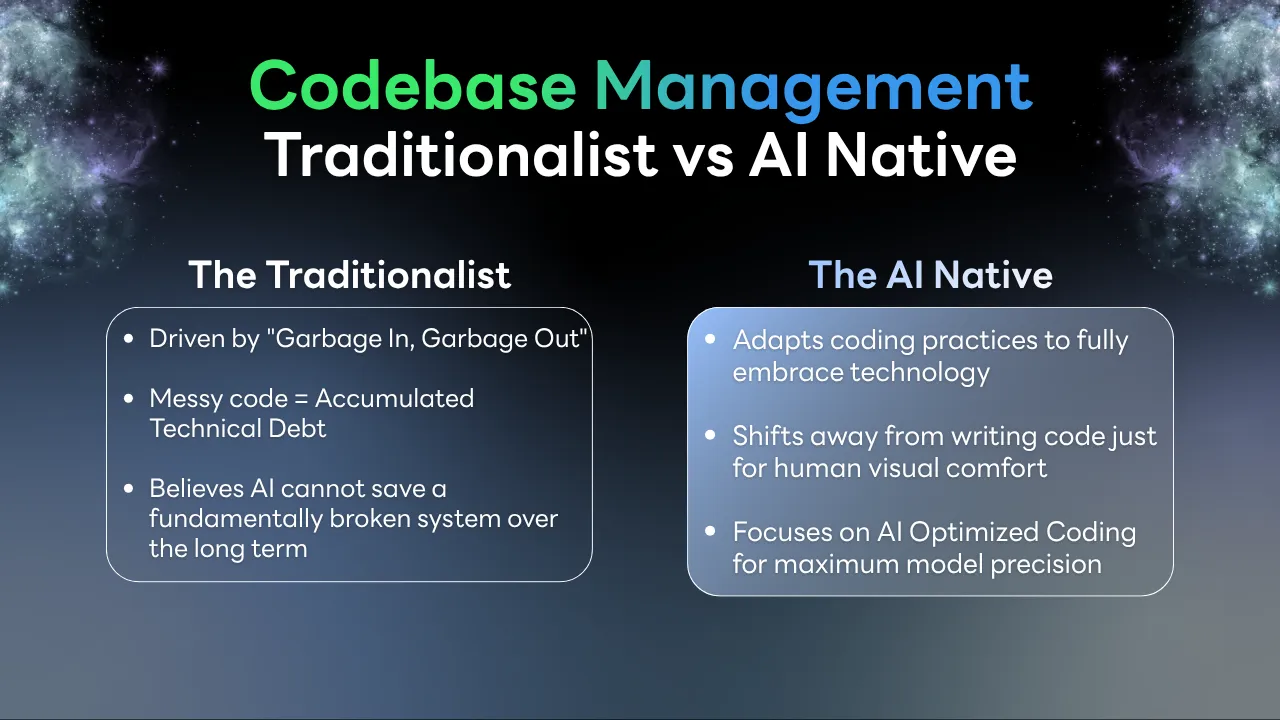
The Traditionalist: Standing firmly by the principle of Garbage In, Garbage Out this school of thought believes that allowing a code structure to become disorganized will accumulate technical debt until the system breaks down, leaving AI unable to assist in managing it over the long term.
The AI Native: This perspective argues that programming mindsets must evolve to embrace technology, shifting from writing code for human visual comfort to practicing AI Optimized Coding so that models can process the data with the highest possible accuracy.
Guidelines for Evolving Clean Code into Context Efficiency
Contemporary Clean Code concepts are being redefined through the lens of Context Efficiency the practice of enabling AI to understand system requirements with maximum accuracy and minimal resource consumption. This approach is built upon three core principles:
1. Applying the Locality of Behavior (LoB) Concept to Software Architecture
The traditional rule of the Single Responsibility Principle (SRP) has often been interpreted as breaking functions down into short segments and splitting them into small, separate files. However, scattering logic across multiple files leads to the issue of Context Fragmentation.
The AI Native Approach: Shifting toward the Locality of Behavior (LoB) concept, where code is written so that related logic resides as close together as possible (Inlining). Keeping the entire context within a single file reduces the need for cross-file Retrieval Augmented Generation (RAG) and minimizes the risk of vital information being overlooked.
2. Establishing Semantic Naming Conventions to Mitigate AI Hallucination
Naming variables or functions with overly short or abstract terms might look clean to human eyes, but it creates ambiguity for AI systems.
The AI Native Approach: Prioritizing Explicit & Semantic naming conventions that clearly state responsibilities and intents for instance, userRegistrationStatus_validatedByAuthService. Although the names become longer, they significantly reduce the rate of hallucination (AI processing errors) because LLMs operate by capturing the semantic meaning of words.
3. Utilizing Strict Typing as Structural Guardrails for AI Agents
Languages with Strict Typing systems, such as TypeScript, Rust, or Mojo, have become essential standards because the type system acts as a definitive specification.
Technical Insight: Implementing Strict Typing alongside rigid data structures (such as Zod Schemas) serves as a guardrail that prevents the AI from generating off track code. When the AI knows the exact shape of the data structure, its efficiency and precision in code analysis increase.
Conceptual Comparison: Clean Code (2008) vs AI Native Code (2026)
Technical Feature | Clean Code (2008) | AI Native Code (2026) |
Architectural Structure | Heavy abstraction split into hyper granular files | Locality of Behavior (Centralized context) |
Naming Conventions | Short, concise, and focused on aesthetics | Long, explicit, and intent driven (Semantic) |
System Documentation | Writing comments to explain functionality (What) | Leveraging the Type System to set boundaries and define intent (Why) |
Primary Goal | Optimized for human readability and comprehension | Optimized for precise AI maintenance and token conservation |
Adaptive Skills for the Developer's Role as an AI Orchestrator
The developer's role is shifting away from manually typing syntax toward effectively directing, auditing, and managing operations (Orchestrate & Verify) handled by AI.
Upskilling from Code Writer to System Architect: Focus shifts toward system design and establishing robust interfaces. If the overarching skeleton is architected correctly and clearly, the AI can seamlessly fill in the underlying implementation code.
Elevating the Code Review Process: Human responsibilities will transition to focusing heavily on security audits, exploring edge cases that the AI might overlook, and validating alignment with business logic.
Enforcing Standards via Prompt Based Refactoring: Instead of modifying code line by line, developers will write global specifications (e.g.,
.cursorrulesor.aiconfig) to govern the code generation standards of AI agents across the entire project.
Core Principle: Clean Code is evolving from line-level craftsmanship into system-level engineering. Developers must act as controllers of these standards, leveraging tools to drive maximum operational efficiency.
Q&A: Conceptual Analysis of Clean Code and AI Collaboration
Q1: If AI can process highly complex code can developers just write Spaghetti Code?
Answer: Absolutely not. Because AI operates on probabilistic principles, unnecessary accidental complexity increases the likelihood of inference errors. Furthermore, during critical emergencies that require manual intervention, unorganized code becomes a massive bottleneck that delays system recovery.
Q2: How does breaking code into hyper-granular, small functions negatively impact AI from a technical standpoint?
Answer: Over fragmenting files or functions triggers continuous context switching. This forces the AI to consume a higher volume of tokens to retrieve relevant context via RAG systems and can cause the model to lose track of the execution order (Call Stack). Grouping related commands cleanly within cohesive modules (Encapsulation) optimizes token costs and yields higher accuracy.
Q3: Is writing comments in the source code still necessary?
Answer: It is more necessary than ever, but the core objective has shifted. Instead of explaining what the code does, comments should now articulate why it does it (Intent). This ensures AI agents understand the underlying business objectives and constraints, preventing the model from altering or stripping out critical logic during automated refactoring.
Q4: Is it necessary to separate an AI Style Guide from a Human Style Guide?
Answer: Yes, it is becoming essential. Many engineering teams have begun utilizing dedicated configuration files like .cursorrules or .aiconfig to set explicit programming guidelines specifically for AI agents. This represents an evolution beyond traditional linters, as it dictates the reasoning and code generation behaviors of the AI to align with organization wide standards.
Q5: What is the single most critical technical skill for software developers right now?
Answer: System Design & Verification. While AI excels at generating granular, isolated functions, it still lacks a holistic view of macro-level system architecture. Knowing how to design a system that is resilient, secure, and fully auditable is the true definition of modern Clean Code.
Conclusion
Clean Code is not disappearing from the software development industry. Rather, it is evolving from serving human visual layout preferences toward designing architectures that facilitate the most seamless, optimized, and powerful collaboration with AI.
Follow Superdev Academy on all platforms:
🔵 Facebook: Superdev Academy Thailand
🎬 YouTube: Superdev Academy Channel
📸 Instagram: @superdevacademy
🎬 TikTok: @superdevacademy
🌐 Website: superdevacademy.com