07/06/2026 06:43am
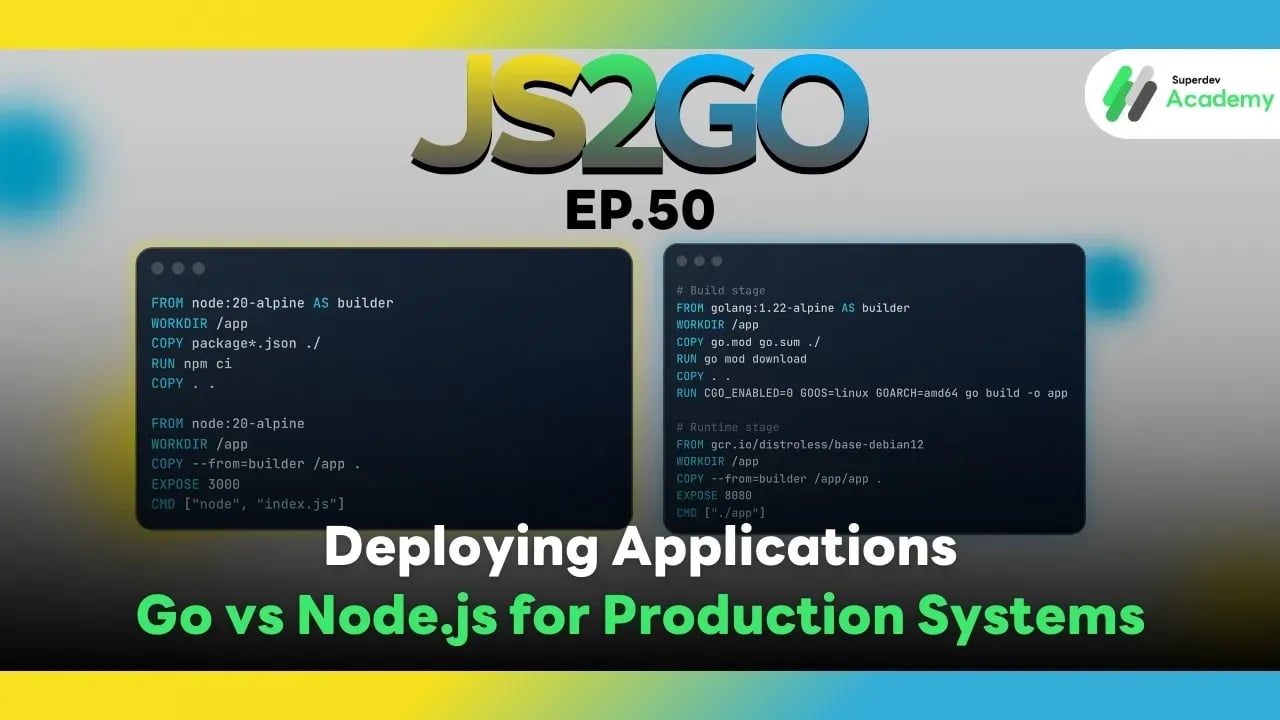
JS2GO EP.50 Deploying Applications: Go vs Node.js for Production Systems
#Deploy Application
#Go
#Node.js
#Production
From Local Code to a Real Production System, Go vs Node.js: End-to-End Deployment in the Real World
Many projects don’t fail because of bad code.
They fail because their deployment is not ready for the real world.
A system that runs on your local machine
≠
A system that survives real users, real traffic, and real incidents.
This article marks the final episode of the JS2GO series. It provides an end-to-end overview of production deployment, comparing Go vs Node.js across everything that actually matters in the real world from build strategies, Docker, secrets management, CI/CD pipelines, all the way to zero-downtime deployment.
Everything here is based on what teams face in real production environments.
1️⃣ Build & Deploy: Fundamental Differences
🔹 Go
- Compiles into a single binary
- No runtime required at execution time
- Clear artifact → easy deployment → easier debugging
- Well-suited for Containers, VMs, and Bare Metal
🔹 Node.js
- Requires a Node.js runtime
- Relies on
package.jsonandnode_modules - Large and flexible ecosystem
- Requires strict dependency and version management
| Aspect | Go | Node.js |
|---|---|---|
| Output | Single binary | JS + node_modules |
| Runtime | Not required | Required |
| Cold start | Very fast | Slightly slower |
| Simplicity | High | Moderate |
📌 Production insight
- Go excels in deployment simplicity
- Node.js excels in developer velocity and ecosystem strength
2️⃣ Docker & Multi-stage Builds (The Core of Production)
🐳 Go: Multi-stage Docker (Best Practice)
# Build stage
FROM golang:1.22-alpine AS builder
WORKDIR /app
COPY go.mod go.sum ./
RUN go mod download
COPY . .
RUN CGO_ENABLED=0 GOOS=linux GOARCH=amd64 go build -o app

# Runtime stage
FROM gcr.io/distroless/base-debian12
WORKDIR /app
COPY --from=builder /app/app .
EXPOSE 8080
CMD ["./app"]
Advantages
- Extremely small image
- Low attack surface
- Fast startup
- Ideal for long-term production use
🐳 Node.js: Multi-stage Docker
FROM node:20-alpine AS builder
WORKDIR /app
COPY package*.json ./
RUN npm ci
COPY . .

FROM node:20-alpine
WORKDIR /app
COPY --from=builder /app .
EXPOSE 3000
CMD ["node", "index.js"]
Things to watch out for
- Large
node_modules - Dependency explosion
- Always use
npm ciwith a lock file
📌 Rule of thumb
A good production Node.js system requires deterministic dependencies.
3️⃣ Secrets & Environment Variables (Non-Negotiable)
❌ Never do this
- Hardcode database passwords
- Commit JWT secrets
- Push API keys to repositories
✅ Correct approach
- Environment variables
- Secret managers
- Injection via CI/CD
Go
dbURL := os.Getenv("DATABASE_URL")
Node.js
const dbUrl = process.env.DATABASE_URL;
📌 Production-ready tools
- AWS Secrets Manager
- GCP Secret Manager
- HashiCorp Vault
- Kubernetes Secrets
4️⃣ CI/CD Pipeline (Professional Deployment)
Typical flow
Git Push
 → Test
   → Build
     → Docker Build
       → Push Image
         → Deploy
GitHub Actions (example)
name: Deploy
on: [push]
jobs:
  build:
    runs-on: ubuntu-latest
    steps:
      - uses: actions/checkout@v4
      - run: docker build -t app .
Best practices
- Tests must pass before deployment
- Separate staging and production
- Use version tags (e.g.
v1.2.0) - Deploy images, not source code
5️⃣ Zero-downtime Deployment
Goal: users should never notice your deployment.
Proven techniques
- Rolling Update
- Blue-Green Deployment
- Canary Release
Kubernetes concept
strategy:
  type: RollingUpdate
- New pods start first
- Old pods terminate gradually
- No downtime
Node.js with PM2
pm2 reload ecosystem.config.js
PM2 will:
- Spin up new processes
- Gracefully shut down old ones
6️⃣ Process Management
| Aspect | Go | Node.js |
|---|---|---|
| Process manager | systemd / Kubernetes | PM2 |
| Auto-restart | Yes | Yes |
| Logs | stdout | stdout |
Go + systemd
[Service]
ExecStart=/app/server
Restart=always
Node.js + PM2
pm2 start index.js -i max
7️⃣ Monitoring After Deployment (Often Overlooked)
✔ Health checks
✔ Metrics (CPU / Memory)
✔ Logs
✔ Alerts
A good production system detects problems before users do.
8️⃣ Production Checklist (Before You Deploy)
🔐 Security
- HTTPS everywhere
- No secrets in repositories
- Rate limiting
- Input validation
⚙️ Performance
- Connection pooling
- Timeouts
- Graceful shutdown
📦 Deployment
- Small Docker images
- Multi-stage builds
- Versioned images
🔍 Observability
- Logs
- Metrics
- Alerts
9️⃣ Go vs Node.js in Production
| Perspective | Go | Node.js |
|---|---|---|
| Deployment simplicity | ⭐⭐⭐⭐⭐ | ⭐⭐⭐ |
| Ecosystem | ⭐⭐⭐ | ⭐⭐⭐⭐⭐ |
| Performance | ⭐⭐⭐⭐⭐ | ⭐⭐⭐⭐ |
| Scalability | ⭐⭐⭐⭐⭐ | ⭐⭐⭐⭐ |
| Developer speed | ⭐⭐⭐⭐ | ⭐⭐⭐⭐⭐ |
📌 There is no “best” language. There is only the right language for the system you are building.
🎉 Closing the JS2GO Series
Throughout this series, you’ve covered:
- Syntax
- Concurrency
- Performance
- Architecture
- Security
- Deployment
If you’ve reached EP.50, you’re no longer someone who just writes code. You understand how to build real production systems 💪🔥