18/09/2026 22:16pm
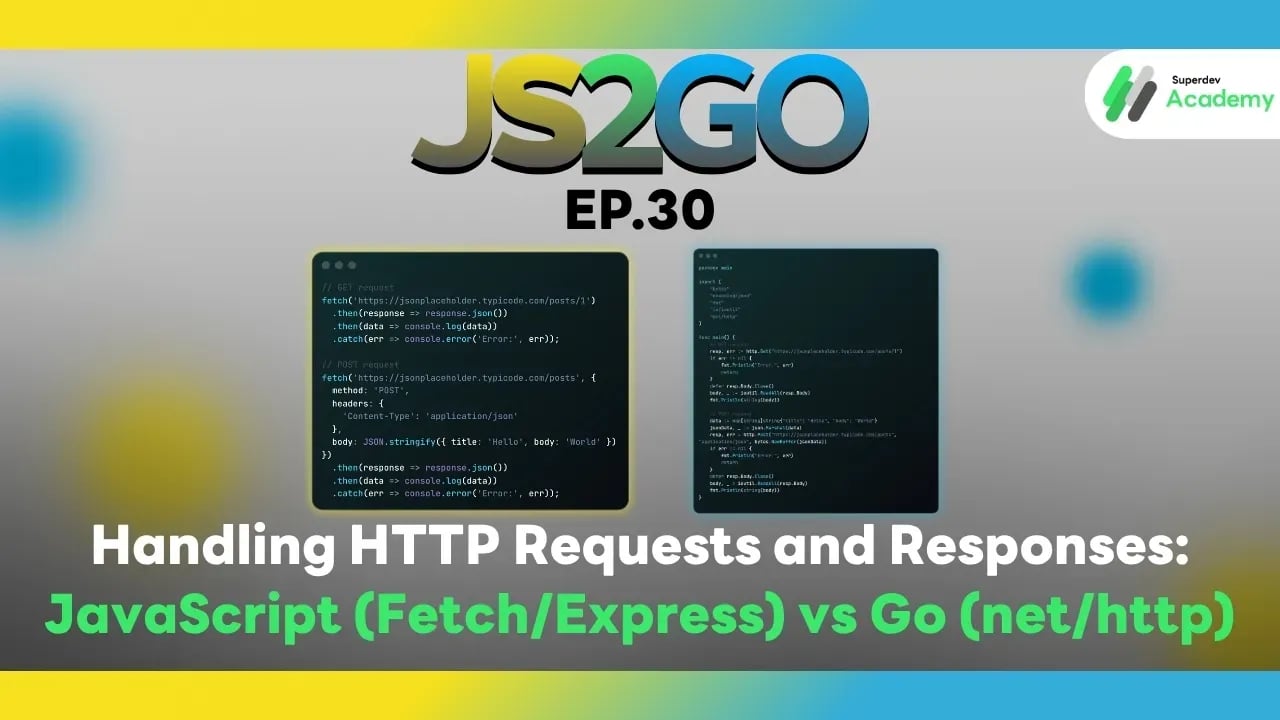
JS2GO EP.30 Handling HTTP Requests and Responses: JavaScript (Fetch/Express) vs Go (net/http)
#HTTP Requests
#HTTP Responses
#JavaScript Fetch
#Go net/http
#Golang
#JavaScript
HTTP is a core protocol for communication between clients and servers, essential for building APIs and web applications. In this article, we compare handling HTTP requests and responses in JavaScript (Node.js + Fetch/Express) and Go (net/http), with clear examples and best practices for production-ready applications.
1. HTTP Requests in JavaScript
Client-side: Fetch API
// GET request
fetch('https://jsonplaceholder.typicode.com/posts/1')
  .then(response => response.json())
  .then(data => console.log(data))
  .catch(err => console.error('Error:', err));

// POST request
fetch('https://jsonplaceholder.typicode.com/posts', {
  method: 'POST',
  headers: {
    'Content-Type': 'application/json'
  },
  body: JSON.stringify({ title: 'Hello', body: 'World' })
})
  .then(response => response.json())
  .then(data => console.log(data))
  .catch(err => console.error('Error:', err));
Advantages:
✔️ Concise syntax, compatible with async/await
✔️ Built-in JSON support, flexible headers and HTTP methods
Server-side: Express
const express = require('express');
const app = express();
app.use(express.json());

app.get('/api/posts/:id', (req, res) => {
  res.json({ id: req.params.id, title: 'Hello', body: 'World' });
});

app.post('/api/posts', (req, res) => {
  const { title, body } = req.body;
  res.status(201).json({ id: 1, title, body });
});

app.listen(3000, () => console.log('Server running on port 3000'));
Advantages:
✔️ Easy routing and middleware
✔️ Automatic JSON parsing, supports authentication, logging
2. HTTP Requests in Go
Client-side: HTTP GET / POST
package main

import (
    "bytes"
    "encoding/json"
    "fmt"
    "io/ioutil"
    "net/http"
)

func main() {
    // GET request
    resp, err := http.Get("https://jsonplaceholder.typicode.com/posts/1")
    if err != nil {
        fmt.Println("Error:", err)
        return
    }
    defer resp.Body.Close()
    body, _ := ioutil.ReadAll(resp.Body)
    fmt.Println(string(body))

    // POST request
    data := map[string]string{"title": "Hello", "body": "World"}
    jsonData, _ := json.Marshal(data)
    resp, err = http.Post("https://jsonplaceholder.typicode.com/posts", "application/json", bytes.NewBuffer(jsonData))
    if err != nil {
        fmt.Println("Error:", err)
        return
    }
    defer resp.Body.Close()
    body, _ = ioutil.ReadAll(resp.Body)
    fmt.Println(string(body))
}
Server-side: net/http
package main

import (
    "encoding/json"
    "fmt"
    "net/http"
)

type Post struct {
    ID    int    `json:"id"`
    Title string `json:"title"`
    Body  string `json:"body"`
}

func getPostHandler(w http.ResponseWriter, r *http.Request) {
    post := Post{ID: 1, Title: "Hello", Body: "World"}
    w.Header().Set("Content-Type", "application/json")
    json.NewEncoder(w).Encode(post)
}

func postPostHandler(w http.ResponseWriter, r *http.Request) {
    var post Post
    json.NewDecoder(r.Body).Decode(&post)
    post.ID = 1
    w.Header().Set("Content-Type", "application/json")
    w.WriteHeader(http.StatusCreated)
    json.NewEncoder(w).Encode(post)
}

func main() {
    http.HandleFunc("/api/posts", postPostHandler)
    http.HandleFunc("/api/posts/1", getPostHandler)
    fmt.Println("Server running on port 3000")
    http.ListenAndServe(":3000", nil)
}
Advantages:
✔️ Type-safe, compile-time checking
✔️ Efficient and lightweight
✔️ Built-in JSON support and HTTP server
3. Best Practices
✔️ Use JSON as the standard data format
✔️ Always check errors and HTTP response status
✔️ Manage headers properly (Content-Type, Authorization)
✔️ Use async/await in JS or Goroutines in Go for concurrent requests
✔️ Separate client and server logic clearly
4. Comparison: JavaScript vs Go HTTP
| Feature | JavaScript (Fetch/Express) | Go (net/http) |
|---|---|---|
| Client | fetch / axios | http.Get / http.Post |
| Server | Express | net/http |
| JSON | Auto parsing / stringify | json.Marshal / json.Unmarshal |
| Concurrency | async/await / Promises | Goroutines |
| Type Safety | Dynamic | Static |
| Middleware | Express supports middleware | net/http handlers, optional middleware |
Recommendations:
✔️ Frontend & lightweight APIs → JavaScript Fetch + Express
✔️ High-performance backend / type-safe APIs → Go net/http
Next Episode
In EP.31 of the JS2GO series, we will explore Queues and Stacks in JavaScript and Go to understand linear data structures and how to use them efficiently in real-world applications.
Read more
🔵 Facebook: Superdev Academy
🔴 YouTube: Superdev Academy
📸 Instagram: Superdev Academy
🎬 TikTok: https://www.tiktok.com/@superdevacademy?lang=th-TH
🌐 Website: https://www.superdevacademy.com/en