07/06/2026 06:43am
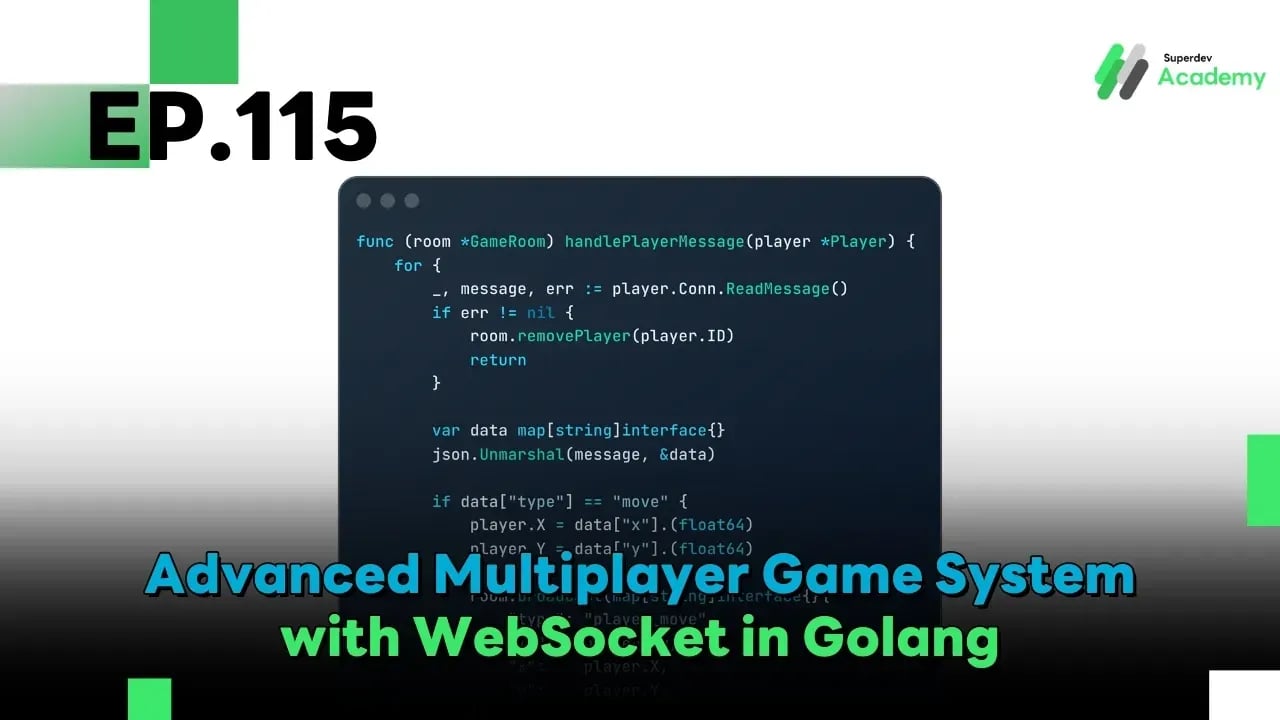
EP.115 Advanced Multiplayer Game System with WebSocket in Golang
#Multiplayer Game
#WebSocket Server
#WebSocket
#Go
#Golang
Creating a real-time multiplayer game like a battle arena, co-op, or shooting game requires an ultra-fast system that can transmit high-frequency data such as:
- Player positions
- Attacks
- Jumps
- Game events
And Go + WebSocket is the perfect combination for this challenge.
✅ Why Go + WebSocket?
- Low latency
- Bi-directional communication
- Supports tens of thousands of concurrent connections
- Goroutines in Go are lightweight and efficient for handling many WebSocket clients
🧠 Core Challenges of Real-Time Multiplayer Games
1. Player State Sync
All players must see the same data: HP, score, status, etc.
2. Position Sync
Player X/Y/Z coordinates must update in real-time.
3. Event Sync
When someone shoots, jumps, or picks up an item, all players must know instantly.
⚠️ If syncing is delayed even by 100–200ms, users will feel laggy or unresponsive gameplay.
🧩 Designing Game Rooms
In real-world multiplayer games, players are not all in a single room. They're divided into multiple rooms (instances).
type Player struct {
    ID    string
    X     float64
    Y     float64
    Conn  *websocket.Conn
}

type GameRoom struct {
    ID      string
    Players map[string]*Player
    Mutex   sync.Mutex
}
Each room holds multiple players. The Mutex ensures safe concurrent access. Whenever a player moves, the new position is broadcasted to all others in the same room.
⚙️ Receiving & Broadcasting Player Position
Handling client message:
func (room *GameRoom) handlePlayerMessage(player *Player) {
    for {
        _, message, err := player.Conn.ReadMessage()
        if err != nil {
            room.removePlayer(player.ID)
            return
        }

        var data map[string]interface{}
        json.Unmarshal(message, &data)

        if data["type"] == "move" {
            player.X = data["x"].(float64)
            player.Y = data["y"].(float64)

            room.broadcast(map[string]interface{}{
                "type": "player_move",
                "id":   player.ID,
                "x":    player.X,
                "y":    player.Y,
            })
        }
    }
}
Broadcasting to everyone in the room:
func (room *GameRoom) broadcast(msg interface{}) {
    room.Mutex.Lock()
    defer room.Mutex.Unlock()

    jsonMsg, _ := json.Marshal(msg)

    for _, p := range room.Players {
        p.Conn.WriteMessage(websocket.TextMessage, jsonMsg)
    }
}
🔧 How to Reduce Latency Like a Pro
| Technique | Explanation |
|---|---|
| Delta Update | Send updates only when data changes (not every 16ms) |
| Binary Protocol | Reduce message size (e.g., JSON 58 bytes → Binary 12 bytes) |
| Client-side Prediction | Let the client predict movement, and server corrects it |
| Game Tick Loop | Use constant tick rate: 20, 30, or 60 ticks/sec |
| WebSocket Compression | Reduce WebSocket message size |
🔐 Handling Disconnected Players
func (room *GameRoom) removePlayer(playerID string) {
    room.Mutex.Lock()
    delete(room.Players, playerID)
    room.Mutex.Unlock()

    room.broadcast(map[string]interface{}{
        "type": "player_left",
        "id":   playerID,
    })
}
When a player disconnects, they are removed from the room and all others are notified immediately.
🏗 Building a Production-Ready Multiplayer System
| Component | Reason |
|---|---|
| Redis Pub/Sub | Sync states across servers |
| Load Balancer + Sticky Session | Handle high traffic with stable routing |
| Matchmaking Service | Automatically assign players to rooms |
| JWT + Device ID | Secure session management |
| Anti-cheat Middleware | Prevent teleport or speed hacks |
| Game Analytics | Understand user behavior and system performance |
🎯 Challenge Yourself!
Try building a simple game like:
- ✅ 2D Arena Game
- ✅ Multiplayer Drawing Board
- ✅ Real-time Movement Demo
Make it work with 10 players moving simultaneously. If you succeed congratulations, you've taken your first real step into building professional multiplayer systems with Go + WebSocket! 🚀
🔮 Next Episode EP.116: Real-time Voice/Video with WebRTC
In the next episode, you’ll explore how to build:
- WebRTC Peer Connections
- WebSocket Signaling
- Real-time Voice & Video Chat system
You'll learn how to integrate WebRTC with WebSocket to build Zoom/Discord-like features for your app!