18/09/2026 22:12pm
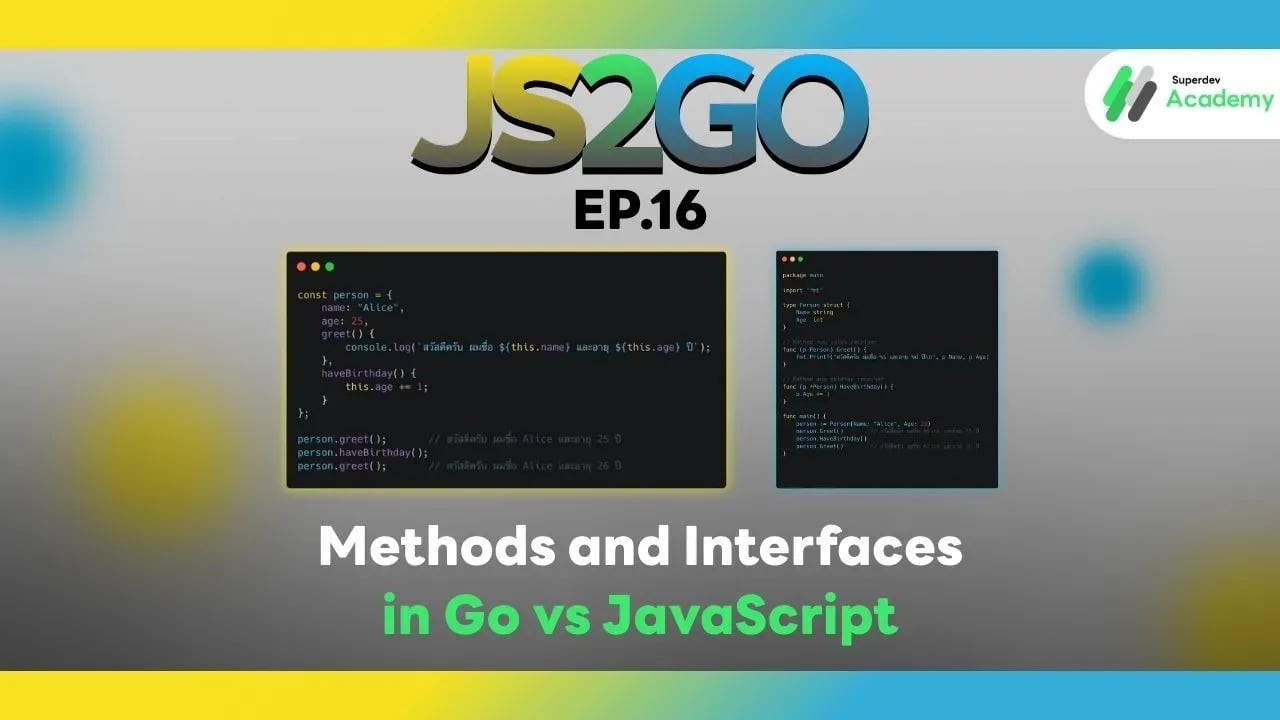
JS2GO EP.16 Methods and Interfaces in Go vs JavaScript
#JS2GO
#Interfaces JavaScript
#Methods JavaScript
#Interfaces Go
#Methods Go
Methods and Interfaces are fundamental concepts in object-oriented programming and data structure design. Understanding how to create and use Methods and Interfaces allows you to write flexible, readable code and manage functions within structs or objects efficiently.
This article compares how Methods and Interfaces work in Go and JavaScript/TypeScript, with code examples, pros and cons, and usage recommendations.
Methods in Go
In Go, Methods are functions attached to structs. You can use value receivers or pointer receivers to handle struct values.
Example of Methods
package main

import "fmt"

type Person struct {
    Name string
    Age  int
}

// Value receiver
func (p Person) Greet() {
    fmt.Printf("Hello, my name is %s and I am %d years old\n", p.Name, p.Age)
}

// Pointer receiver
func (p *Person) HaveBirthday() {
    p.Age += 1
}

func main() {
    person := Person{Name: "Alice", Age: 25}
    person.Greet()        // Hello, my name is Alice and I am 25 years old
    person.HaveBirthday()
    person.Greet()        // Hello, my name is Alice and I am 26 years old
}
Pros
- ✨ Type-safe and clearly bound to structs
- ✨ Pointer receivers allow modifying struct values
Cons
- ⚠️ Structs must be declared before defining methods
- ⚠️ No class-based inheritance
Interfaces in Go
Interfaces define the behavior of structs. Any struct implementing the required methods can be used wherever the interface is expected.
Example of Interfaces
package main

import "fmt"

type Greeter interface {
    Greet()
}

type Person struct {
    Name string
}

func (p Person) Greet() {
    fmt.Println("Hello, my name is", p.Name)
}

type Robot struct {
    ID int
}

func (r Robot) Greet() {
    fmt.Println("Beep boop! I am robot", r.ID)
}

func SayHello(g Greeter) {
    g.Greet()
}

func main() {
    alice := Person{Name: "Alice"}
    r2d2 := Robot{ID: 101}

    SayHello(alice)  // Hello, my name is Alice
    SayHello(r2d2)   // Beep boop! I am robot 101
}
Pros
- ✨ Decouples code and increases flexibility
- ✨ Any struct implementing the interface can be used immediately
Cons
- ⚠️ No enforcement of interface implementation
- ⚠️ Can be confusing for beginners
Methods and Objects in JavaScript
In JavaScript, Methods are functions inside objects or classes.
Example: Methods in Objects
const person = {
    name: "Alice",
    age: 25,
    greet() {
        console.log(`Hello, my name is ${this.name} and I am ${this.age} years old`);
    },
    haveBirthday() {
        this.age += 1;
    }
};

person.greet();       // Hello, my name is Alice and I am 25 years old
person.haveBirthday();
person.greet();       // Hello, my name is Alice and I am 26 years old
Example: Methods in Classes
class Person {
    constructor(name, age) {
        this.name = name;
        this.age = age;
    }

    greet() {
        console.log(`Hello, my name is ${this.name} and I am ${this.age} years old`);
    }

    haveBirthday() {
        this.age += 1;
    }
}

const alice = new Person("Alice", 25);
alice.greet();
alice.haveBirthday();
alice.greet();
Pros
- ✨ Flexible and easy to use
- ✨ Supports class-based and prototype-based OOP
Cons
- ⚠️ Not type-safe
- ⚠️ No built-in interface (requires TypeScript or design patterns)
Interface Pattern in TypeScript
In JavaScript, interfaces can be implemented using TypeScript:
interface Greeter {
    greet(): void;
}

class Person implements Greeter {
    constructor(public name: string) {}
    greet() {
        console.log(`Hello, my name is ${this.name}`);
    }
}

class Robot implements Greeter {
    constructor(public id: number) {}
    greet() {
        console.log(`Beep boop! I am robot ${this.id}`);
    }
}

function sayHello(g: Greeter) {
    g.greet();
}

const alice = new Person("Alice");
const r2d2 = new Robot(101);

sayHello(alice);  // Hello, my name is Alice
sayHello(r2d2);   // Beep boop! I am robot 101
Comparison: Methods and Interfaces
| Feature | Go | JavaScript/TypeScript |
|---|---|---|
| Method Binding | Bound to struct or pointer | Bound to object or class |
| Interface | Built-in, decoupled behavior | No built-in, use pattern/TypeScript |
| Type Safety | High | Low |
| Inheritance | No class-based inheritance | Supports class-based inheritance |
| Use Case | Large systems, strict typing | Web apps, flexible OOP |
Summary and Recommendations
- Go: Methods and Interfaces are ideal for large systems requiring type safety and behavior flexibility
- JavaScript/TypeScript: Methods in objects or classes are suitable for web applications and highly flexible code
- Choose based on project type and needs for function and behavior management
Next Episode
In EP.17 of the JS2GO series, we will explore debugging in Go and JavaScript to make inspecting and fixing code errors easier and more effective.
Read more
🔵 Facebook: Superdev Academy
📸 Instagram: Superdev Academy
🎬 TikTok: https://www.tiktok.com/@superdevacademy?lang=th-TH
🌐 Website: https://www.superdevacademy.com/en