07/06/2026 06:43am
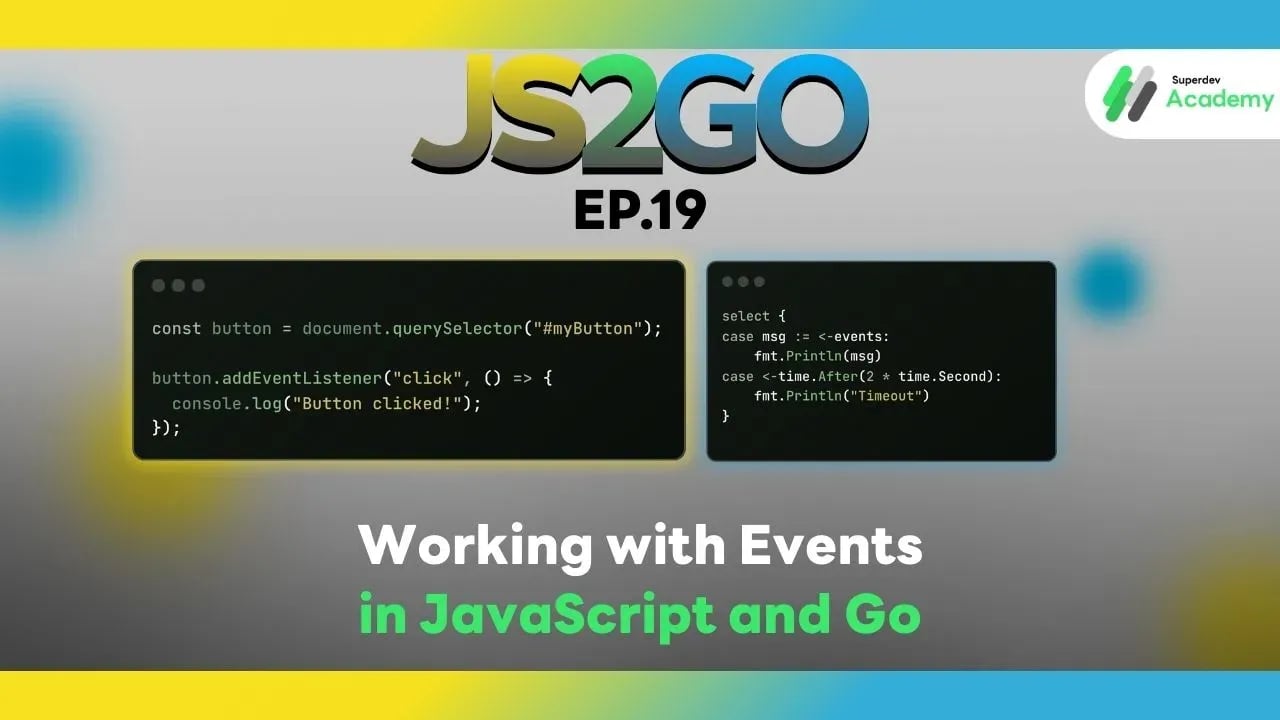
JS2GO EP.19 Working with Events in JavaScript and Go – Event Loop, Goroutines, and Channels
#Concurrent Programming
#Channels
#Goroutines
#Event Loop
#Go Events
#JavaScript Events
Event handling is a core aspect of programming, whether it involves user interactions, asynchronous processing, or real-time systems. In this article, we will compare how Events are handled in JavaScript and Go, while learning best practices for each language to help you develop efficient, reliable, and error-resistant systems.
Event Handling in JavaScript
1. Event-driven Programming in JavaScript
JavaScript is inherently event-driven, especially in web browsers. Examples include button clicks, text input, or page load events.
Example: Listening to an event using addEventListener:
const button = document.querySelector("#myButton");

button.addEventListener("click", () => {
  console.log("Button clicked!");
});
Handling asynchronous events with Promises and async/await:
function fetchData() {
  return new Promise((resolve) => {
    setTimeout(() => {
      resolve("Data loaded");
    }, 1000);
  });
}

async function loadData() {
  const data = await fetchData();
  console.log(data);
}

loadData();
2. Event Loop in JavaScript
JavaScript features an Event Loop that enables asynchronous functions to run in a non-blocking manner. These functions are queued and executed after synchronous tasks are completed.
Advantages:
- Flexible event handling
- Supports asynchronous operations
Disadvantages:
- Requires understanding of the Event Loop to avoid callback hell or race conditions
Event Handling in Go
1. Event Handling in Go
Go is a concurrency-oriented language. Event handling often uses Goroutines and Channels to communicate between processes.
Example: Using Goroutines and Channels:
package main

import (
    "fmt"
    "time"
)

func main() {
    events := make(chan string)

    go func() {
        time.Sleep(1 * time.Second)
        events <- "Event received!"
    }()

    msg := <-events
    fmt.Println(msg)
}
Explanation:
eventsis a Channel for sending data between Goroutines- Goroutines run concurrently
msg := <-eventswaits until a value is sent through the channel
2. Event-driven Pattern in Go
Go does not have an Event Loop like JavaScript. To implement an event-driven system, you need to structure it manually, for example using select with Channels:
select {
case msg := <-events:
    fmt.Println(msg)
case <-time.After(2 * time.Second):
    fmt.Println("Timeout")
}
Advantages:
- Go’s concurrency is fast and thread-safe
- Handling multiple events simultaneously is easy using Channels
Disadvantages:
- Requires understanding of Goroutines and Channels
- Event-driven architecture must be designed manually
Comparing Event Handling: JavaScript vs Go
| Feature | JavaScript | Go |
|---|---|---|
| Core Mechanism | Event Loop, Non-blocking | Goroutines + Channels, Concurrency |
| Async Event Handling | Promises, async/await | Goroutines + Channels |
| Ease of Getting Started | Easy for Web UI and Node.js | Must understand Concurrency and Channels |
| Concurrent Execution | Non-blocking, but careful of race conditions | Handles multiple events simultaneously well |
| Typical Use Case | Web Applications, Asynchronous I/O | Server, Backend, Concurrent Processing |
Best Practices
JavaScript
- Use
addEventListeneroron[event]for DOM events - Prefer Promises or
async/awaitover nested callbacks - Be cautious of race conditions and state management in asynchronous operations
Go
- Use Goroutines for concurrent tasks
- Use Channels to send and receive events between Goroutines
- Use
selectto handle multiple events or implement timeouts - Design your event-driven system according to the program’s concurrency requirements
Summary
- JavaScript is ideal for event-driven programming in web and Node.js environments, leveraging the Event Loop and
async/await. - Go excels in concurrent event handling using Goroutines and Channels, making it perfect for backend and server applications.
- Choosing the right event handling approach depends on the project type and programming language. Understanding each language’s event principles ensures more efficient, reliable, and robust applications.
Next Episode
In EP.20 of the JS2GO series, we will explore Testing in Go and JavaScript to help you write high-quality, safe, and reliable code that works as expected.
Read more
🔵 Facebook: Superdev Academy
🔴 YouTube: Superdev Academy
📸 Instagram: Superdev Academy
🎬 TikTok: https://www.tiktok.com/@superdevacademy?lang=th-TH
🌐 Website: https://www.superdevacademy.com/en