07/06/2026 06:43am
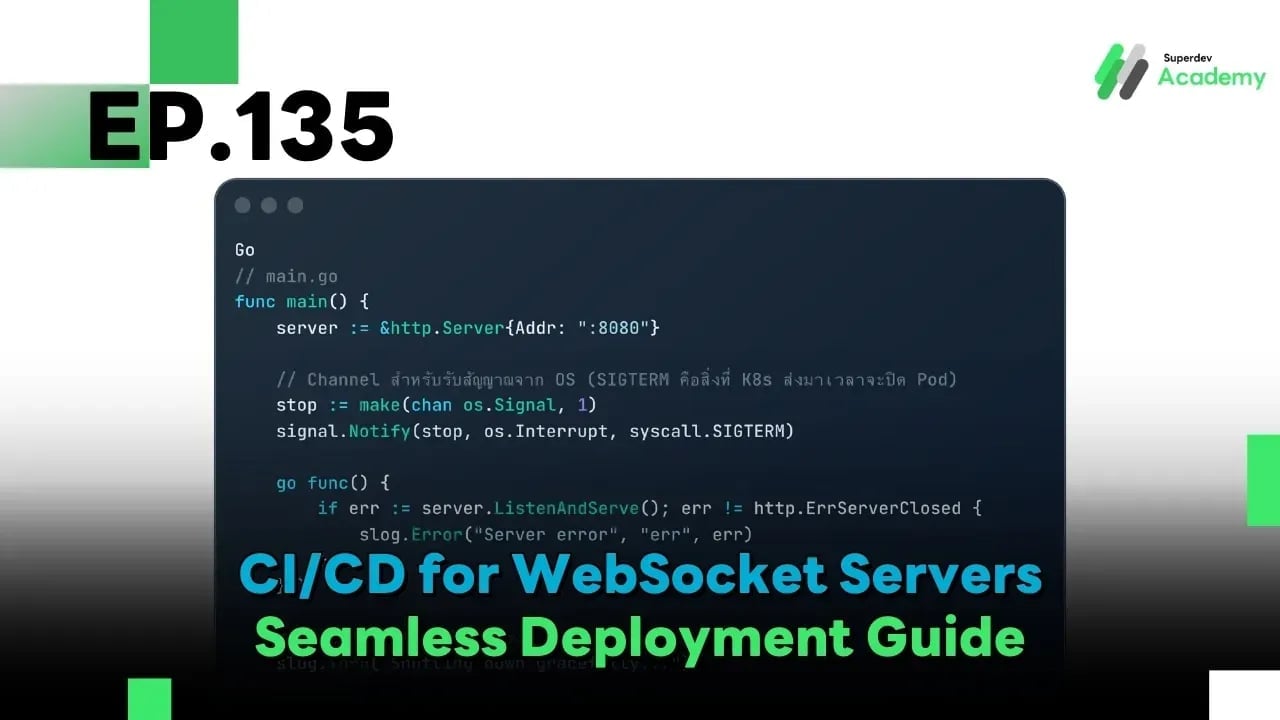
Golang The Series EP 135: CI/CD for WebSocket Servers – Seamless Deployment Guide
#Golang
#CI/CD
#WebSocket
#Docker
#Deploy
Welcome back, Gophers! We’ve reached EP 135. After pushing our system to its breaking point in the last episode (Load Testing), it’s time to talk about the system that makes a developer's life easier and safer: Continuous Integration & Continuous Deployment (CI/CD).
But wait! Implementing CI/CD for a WebSocket server is significantly more challenging than for a standard REST API. Why? Because WebSockets are Stateful. They maintain active, persistent connections. If you deploy blindly by killing the old process, thousands of users will be disconnected instantly, leading to a Thundering Herd Problem where everyone tries to reconnect at once, potentially crashing your new server before it even starts.
Today, we’ll build a pipeline that is not just about copying files, but about a professional deployment strategy.
1. The Go CI/CD Pipeline: Speed and Security
Go’s fast compilation is a massive advantage. We should leverage this to create a tight, efficient pipeline.
Continuous Integration (CI)
- Linting: Use golangci-lint to maintain code quality and idiomatic standards.
- Unit Testing: Run go test -v -race. The -race flag is non-negotiable for concurrent systems like WebSockets.
- Security Scanning: Use govulncheck (the official Go tool) to identify known vulnerabilities in your dependencies.
Continuous Deployment (CD)
- Build & Push: Create a Docker image (using multi-stage builds to keep it slim) and push it to your private registry.
- Orchestration: Update the image in your cluster (Kubernetes or Docker Swarm) using a strategy that respects stateful connections.
2. Deployment Strategies: Choosing the Right Path
How do we release a new version without frustrating our users? Let’s compare the top strategies:
Pro Tip: For most WebSocket use cases, I recommend a Rolling Update combined with Graceful Shutdown and Client-side Retries. It’s the most balanced approach.
3. The Core: Graceful Shutdown
To ensure a smooth deployment, your server must not "slam the door" on users. It should signal them that it's closing and wait for them to finish.
Go
// main.go
func main() {
    server := &http.Server{Addr: ":8080"}

    // Channel to listen for OS signals (SIGTERM is what K8s sends)
    stop := make(chan os.Signal, 1)
    signal.Notify(stop, os.Interrupt, syscall.SIGTERM)

    go func() {
        if err := server.ListenAndServe(); err != http.ErrServerClosed {
            slog.Error("Server error", "err", err)
        }
    }()

    <-stop // Wait for shutdown signal
    slog.Info("Shutting down gracefully...")

    // Give existing users time to wrap up (e.g., 30 seconds)
    // The server stops accepting NEW connections but keeps old ones alive until timeout
    ctx, cancel := context.WithTimeout(context.Background(), 30*time.Second)
    defer cancel()

    if err := server.Shutdown(ctx); err != nil {
        slog.Error("Forced shutdown", "err", err)
    }
    slog.Info("Server stopped")
}
4. Pipeline Example (GitHub Actions - 2026 Standard)
Here is a .github/workflows/deploy.yml that incorporates security and quality checks:
YAML
name: Go WebSocket CI/CD

on:
  push:
    branches: [ main ]

jobs:
  quality-gate:
    runs-on: ubuntu-latest
    steps:
      - uses: actions/checkout@v4
      - name: Set up Go
        uses: actions/setup-go@v5
        with:
          go-version: '1.26' # Current standard for 2026
      - name: Lint
        run: golangci-lint run
      - name: Security Scan
        run: go install golang.org/x/vuln/cmd/govulncheck@latest && govulncheck ./...
      - name: Test
        run: go test -v -race ./...

  deploy:
    needs: quality-gate
    runs-on: ubuntu-latest
    steps:
      - name: Build and Push Docker
        run: |
          docker build -t superdev/websocket-app:${{ github.sha }} .
          docker push superdev/websocket-app:${{ github.sha }}
      # Add steps for Cloud deployment (e.g., AWS, GCP, or K8s)
5. Client-Side Resilience: Don't Leave Them Hanging
A complete CI/CD system includes "smart" client logic:
- Exponential Backoff: If a connection drops, don't reconnect immediately. Wait 1s, 2s, 4s, etc.
- Jitter: Add randomness to the reconnection time (e.g., $1.2s$ or $0.9s$). This prevents a synchronized mass-reconnection that could crash your new server.
Summary
CI/CD for WebSockets is a blend of Automation and Empathy. By automating your pipeline, you eliminate human error, and by implementing graceful strategies, you respect your users' experience. Now you can ship new features every day without the 2 AM deployment anxiety!
In the Next Episode (EP 136): We’ll tackle another headache—Versioning and Backward Compatibility. How do you upgrade the system while ensuring users on older app versions can still communicate with the new one? Don't miss it!