07/06/2026 06:43am
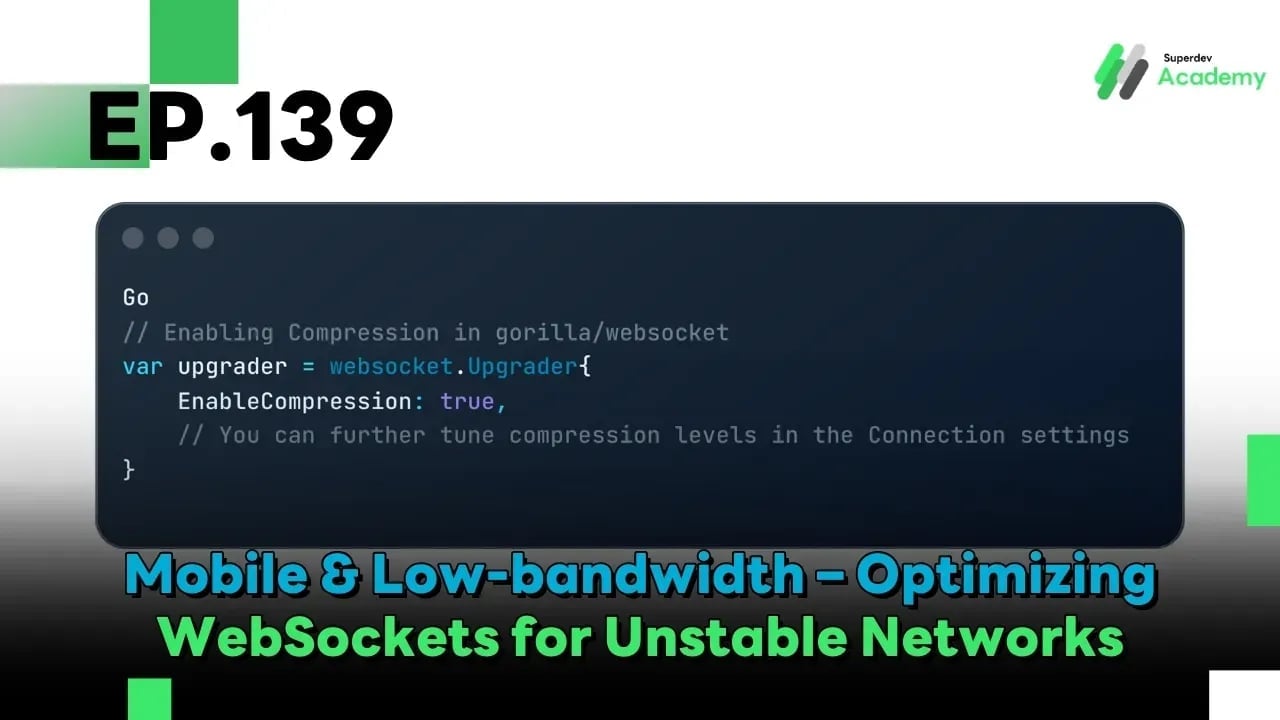
Golang The Series EP.139: Mobile & Low-bandwidth – Optimizing WebSockets for Unstable Networks
#Golang
#WebSocket
#Mobile Development
#Bandwidth Optimization
#Real-time Systems
Keeping WebSockets Fluid on Unstable Networks
Welcome back, Gophers! We are approaching the final stretch of this series. One of the greatest challenges in real-time development isn't when everything is perfect—it's when your user is on a moving train, switching between Wi-Fi and 5G, or stuck with a throttled connection.
Developing WebSockets for mobile means fighting "The Three Demons" of mobile connectivity:
- Unstable Networks: Frequent drops during cell tower handovers or signal loss in dead zones.
- Limited Bandwidth: Throttled data (FUP) or congested areas where data moves at a snail's pace.
- Battery Drain: Keeping a persistent pipe open and constant data transfer is a top-tier battery killer.
Today, we’ll strategize how to make our Go backend "mobile-tough" and battery-friendly.
1. Message Compression: Saving Every Byte
On a slow network, every byte counts. Sending verbose JSON with long keys is a luxury you can't afford when the signal is weak.
- Per-message Deflate: The WebSocket protocol has an extension that allows for DEFLATE compression before sending. In Go, you can enable this easily via the gorilla/websocket package.
- The Trade-off: Compression saves massive bandwidth but increases CPU usage on the server. If you have 100,000+ concurrent users, calculate your resource overhead carefully.
Go
// Enabling Compression in gorilla/websocket
var upgrader = websocket.Upgrader{
    EnableCompression: true,
    // You can further tune compression levels in the Connection settings
}
- Go Expert Tip: For maximum efficiency, switch to Protocol Buffers (Protobuf) as discussed in EP.138. It provides "Structural Compression," which is far more effective than just compressing JSON text.
2. Smart Reconnection: Exponential Backoff & Jitter
When the network drops, clients often try to "hammer" the server to get back in. If 10,000 users drop and reconnect at the exact same millisecond, your server will face a Thundering Herd and likely crash.
The Professional Solution:
- Exponential Backoff: The client should wait progressively longer between retries (e.g., 1s, 2s, 4s, 8s, 16s).
- Jitter (Randomness): This is crucial! Add or subtract a random amount of time (e.g., 1.2s, 0.8s, 4.5s) to desynchronize the reconnection attempts so they don't hit the server in waves.
3. Message Reliability: Sequence Numbers & Catch-up
Mobile connections often go "stale"—the pipe looks open, but data isn't actually moving. This leads to "Ghost Messages" that are sent but never received.
- Sequence Numbers & ACKs: The server should attach a Sequence ID (Seq ID) to every message. The client then sends an ACK (Acknowledgment) saying, "I received up to message 105."
- Resume State: When a client reconnects, it sends its last received Seq ID. The server checks its buffer (or Redis) and sends only the missing messages (106, 107...) instead of forcing a full, heavy state reload.
4. Battery Efficiency: Tuning Heartbeats (Ping/Pong)
Frequent heartbeats (e.g., every 5 seconds) prevent a mobile device's CPU from entering Deep Sleep, causing the battery to drain rapidly.
- Adaptive Heartbeat: If the app is in the Foreground, keep heartbeats frequent. If it’s in the Background, stretch the interval to 30-60 seconds.
- Smart Ping: Only send a Ping if there has been no data activity within the heartbeat window. If you're already sending actual data, the Ping is redundant—skip it!
5. Server-side Throttling & Priority Queues
On a very slow connection, pushing too much data causes Buffer Bloat at the sender's end, causing latency to skyrocket.
- Message Prioritization: Categorize your messages! System alerts or chat messages (Critical) must go first. Analytics or "Friend Online" status (Optional) can wait or be dropped.
- Batching: Instead of sending 10 tiny messages, combine them into a single "Batch" packet to reduce the overhead of WebSocket and TCP headers.
Summary
Developing for Mobile & Low-bandwidth is about designing for the "Worst-case Scenario." If your system feels fluid on a throttled 3G connection, it will feel like magic on 5G or Wi-Fi 6. Caring about battery and data usage is what separates a "functional app" from a "professional-grade product."
In the Next Episode (EP.140): The grand finale of the series! We will present the Enterprise WebSocket Roadmap—summarizing every lesson from EP.1 to now to build a production-ready, real-time architecture that stands the test of time. Don't miss it!