07/06/2026 06:43am
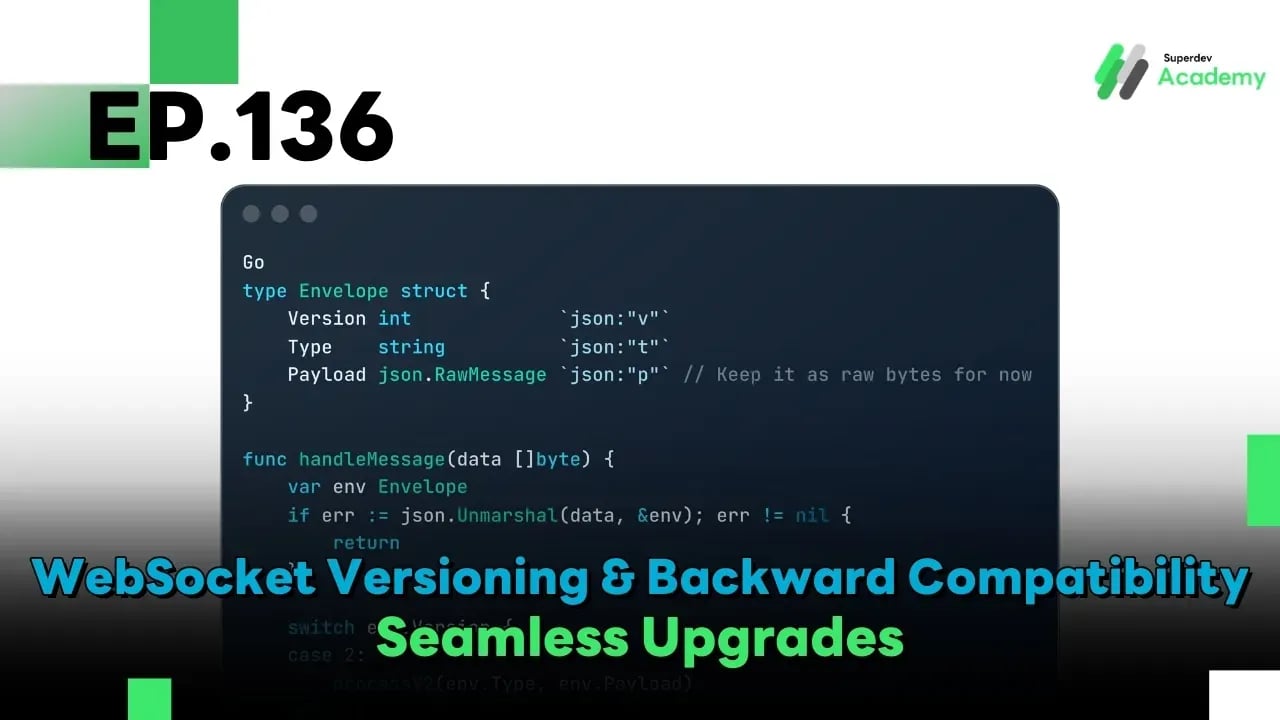
Golang The Series EP.136: WebSocket Versioning & Backward Compatibility – Seamless Upgrades
#Golang
#WebSocket
#Versioning
#Backward Compatibility
#API Design
#Subprotocol
Welcome back, Gophers! In the world of REST APIs, we are all familiar with adding /v1/ or /v2/ to a URL. However, for WebSockets—which are long-lived, stateful connections—versioning is significantly more complex. It’s not just about the "path"; it’s about the Payload Schema that must remain consistent throughout the entire life of the connection.
Today, we’ll explore professional versioning strategies to ensure your system at Superdev Academy can evolve seamlessly without breaking the experience for your existing users.
1. Why is WebSocket Versioning So Challenging?
The difference between REST and WebSocket versioning boils down to these three "pain points":
- The Stateful Lock: Once a client successfully connects, the version is "locked" for the duration of that session. If you deploy a breaking change to the server, you must decide: do you force a disconnect (killing the user experience), or do you support multiple versions simultaneously?
- Asynchronous Complexity: The server might send a new version message to a client still running old code (or vice versa), leading to "unmarshal errors" that can crash your real-time logic.
- Hidden Breaking Changes: Renaming a single field in a JSON payload can turn your real-time system into a "black hole" where data is sent but never understood.
2. Three Strategies for WebSocket Versioning
Strategy 1: Path-based Versioning (Simple & Effective)
Separate endpoints clearly: ws://api.com/v1/chat and ws://api.com/v2/chat.
- Best For: Major architectural shifts (Major Changes).
- Pros: Easy to manage at the API Gateway level; clear separation of logic in your code.
Strategy 2: Subprotocol Negotiation (The IETF Standard)
Utilize the Sec-WebSocket-Protocol header during the handshake to agree on a version.
Go
// Server-side (Go)
var upgrader = websocket.Upgrader{
    // Declare that the server supports both v1 and v2
    Subprotocols: []string{"v1.json", "v2.json"},
}

func (h *Hub) ServeHTTP(w http.ResponseWriter, r *http.Request) {
    conn, _ := upgrader.Upgrade(w, r, nil)
    // You now know exactly which version this client understands
    slog.Info("Client connected", "protocol", conn.Subprotocol())
}
- Pros: Standardized and clean. Client and server reach an agreement before data starts flowing.
Strategy 3: Internal Payload Versioning (Maximum Flexibility)
Embed a version field (e.g., "v": 2) inside every JSON message.
- Best For: Systems with frequent feature updates (Continuous Delivery).
3. Go Implementation: Elegant Backward Compatibility
A pro-tip for Go developers: use json.RawMessage to delay parsing. This prevents "Double Unmarshaling" and saves massive CPU cycles when dealing with multiple versions.
Example: The Elegant Message Router
Go
type Envelope struct {
    Version int             `json:"v"`
    Type    string          `json:"t"`
    Payload json.RawMessage `json:"p"` // Keep it as raw bytes for now
}

func handleMessage(data []byte) {
    var env Envelope
    if err := json.Unmarshal(data, &env); err != nil {
        return
    }

    switch env.Version {
    case 2:
        processV2(env.Type, env.Payload)
    default:
        // Always default to V1 to maintain backward compatibility
        processV1(env.Type, env.Payload)
    }
}
The Golden Rule: Professional backward compatibility is about "Add, Don't Rename." If you need to change a field name, add the new one and keep the old one (mark it as Deprecated) until all users have migrated.
4. The "Sunsetting" Strategy: Saying Goodbye Systematically
You cannot carry technical debt forever. Your plan to decommission old versions should follow these steps:
- Announcement: Send a "System Message" to old clients upon connection, notifying them of the end-of-life date.
- Monitoring (EP.128): Use Grafana to track the percentage of V1 traffic. Once it drops below 1-5%, it’s safe to move to the next phase.
- Brownout Tests: Temporarily disable the old version for short windows (e.g., 15 minutes) to gauge impact before a permanent shutdown.
5. Compatibility in the Microservices Era
If you are using Redis Pub/Sub (from EP.130) as your backplane, remember that messages in Redis are the "universal language."
- Forward Compatibility: Write your old services to use a Permissive Parser—they should be able to ignore new fields they don't recognize without throwing errors.
- Schema Registry: For massive systems, using Protocol Buffers (Protobuf) is superior to JSON as it enforces backward compatibility rules by design.
Summary
Versioning & Backward Compatibility is about showing respect to your users. A cutting-edge system shouldn't leave anyone behind just because they haven't updated their app yet. Planning your versioning strategy today ensures you can sleep soundly when you deploy a major feature tomorrow.
Next Episode (EP.137): We move into the most critical topic of the series: Enterprise WebSocket Security Best Practices. How do you protect an enterprise-grade system from DoS, Hijacking, and Injection? Don't miss it!