18/08/2026 21:48pm
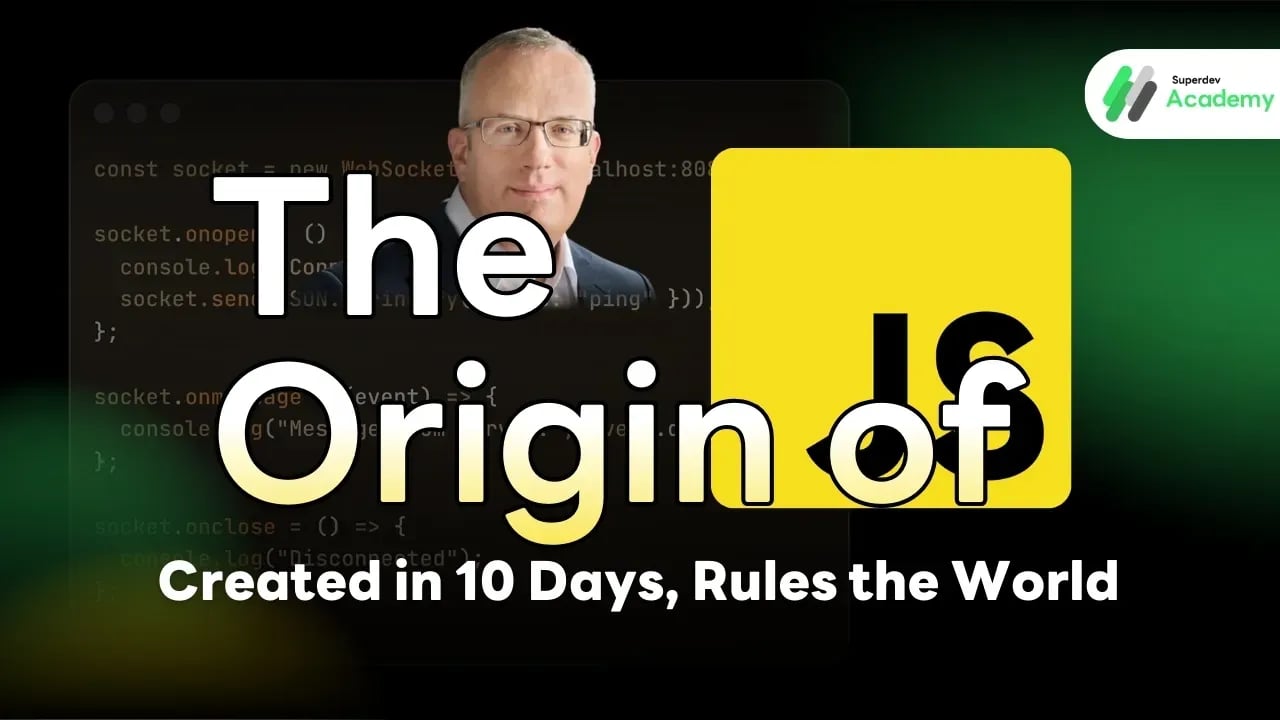
The Origin of JavaScript: Created in 10 Days, Rules the World
#V8 Engine
#Brendan Eich
#JavaScript History
#JavaScript
If we compare the world of software to a skyscraper, C is the foundation buried deep underground, while JavaScript is the "color" and the "mechanics" that make the digital tower move and breathe. From its humble beginnings as a small script for simple web effects, JavaScript has evolved through time to become the vital heart of modern global software.
Today, Superdev Academy takes you back to 1995, during the height of the "Browser Wars," to see how a language created in just 10 days became a global standard.
The Browser Wars and the Need for Speed (1995)
In the early days of the internet, Netscape was the giant ruling the browser market. However, they faced a looming threat from Microsoft, which was preparing to launch Internet Explorer.
At that time, web pages were static—consisting only of text and still images. Netscape needed what they called a "Glue Language"—a language that could make pages dynamic, such as validating forms or creating simple animations. The key requirement was that it had to be "easy enough for non-programmers to use," unlike the complexity of C or Java.
Brendan Eich and the 10-Day Mission
Netscape hired Brendan Eich to build this new language. He was given one of the most high-pressure assignments in software history: design and implement a working language in just 10 days to ship with the release of Netscape Navigator 2.0.
Technical Insight: A Hurried but Genius Design
Despite the rush, Brendan brilliantly synthesized concepts from three major languages:
- Scheme: Adopted the concept of First-class functions (allowing functions to be treated as variables).
- Self: Adopted Prototype-based Inheritance (a style of inheritance different from the Class-based systems found in most languages).
- Java: Adopted the basic Syntax at the request of management to make it look familiar to the programmers of that era.
The Name Trap: JavaScript vs. Java
The language was originally named Mocha, then changed to LiveScript. Eventually, Netscape decided to rename it JavaScript to piggyback on the massive hype surrounding the Java language at the time.
Superdev Note: This is the origin of a legendary confusion! In reality, Java and JavaScript are entirely unrelated. It’s like the difference between "Car" and "Carpet"—they share a few letters but serve completely different purposes.
The Dark Ages and the Birth of ECMAScript
After its launch, JavaScript was often dismissed as a "Toy Language." It was mostly used for annoying features like scrolling status bars or intrusive pop-ups. Furthermore, every browser interpreted JavaScript differently, leading to the developer's nightmare of "Only works in IE" or "Only works in Netscape."
To end this chaos, the language was submitted to ECMA International for standardization. This led to the creation of the ECMAScript (ES) standard in 1997, ensuring that JavaScript would eventually have a consistent global standard.
The Turning Point: V8 Engine and Node.js
The moment JavaScript truly became a powerhouse was in 2008, when Google released the Chrome browser equipped with the V8 Engine.
Technical Insight: JIT Compilation
Before V8, JavaScript relied on an Interpreter, which was slow. V8 introduced JIT (Just-In-Time) Compilation, which translates JavaScript into Machine Code directly during execution. The result was a massive leap in speed, allowing JavaScript to move beyond the browser to the server-side via Node.js in 2009, forever changing the world of web development.
Summary: Why We Must Respect JavaScript
From a language built in 10 days, JavaScript has proven that "Agility and Adaptability" often matter more than initial perfection. Today, you cannot be a Web Developer without knowing JavaScript, and its reach has expanded into Mobile Apps, AI, and Desktop Applications.
📚 Sources
- Eich, B. (2011). "JavaScript: The First 20 Years". Association for Computing Machinery.
- Netscape Communications. (1995). "Press Release: Netscape and Sun announce JavaScript".
- ECMA International. "Standard ECMA-262: ECMAScript Language Specification".