07/06/2026 06:44am
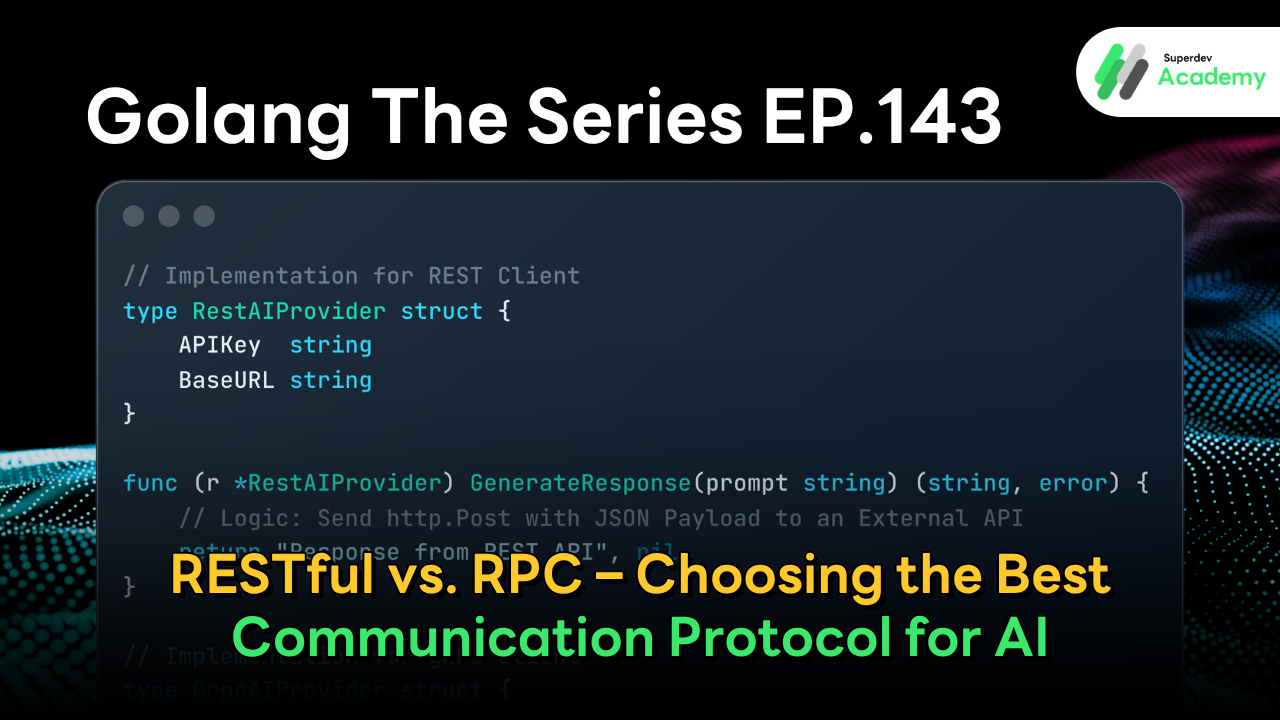
Golang The Series EP.143: RESTful vs. RPC – Choosing the Best Communication Protocol for AI
#RESTful API
#gRPC
#Golang AI
#Golang
#Go
#AI Microservices
#Protocol Buffers
Welcome back to Golang The Series EP.143!
After setting up our AI Lab with Docker in the previous episode, today we are moving on to an element just as crucial as the model itself: Communication Channels.
Once you have a highly intelligent AI model integrated into your system, the heart of the challenge for any developer is: How do we connect and exchange data between the Go backend and those AI models with maximum efficiency?
In this episode, we will dive deep into the clash between two powerhouses:
RESTful API: The popular choice that everyone can access.
gRPC (RPC): The performance express lane for enterprise-grade workloads.
Which one best fits your AI-First projects? Let’s find out!
RESTful API: The Universal Standard
REST (Representational State Transfer) acts as the universal language that Gophers and developers worldwide use daily. It primarily relies on HTTP/1.1 (or HTTP/2) and exchanges data using the familiar JSON Payload format.
Pros:
Universal & Simple: It is highly human-readable and easy to understand. You can debug or inspect data instantly via Postman, cURL, or even a web browser.
Rich Ecosystem: The Go ecosystem is packed with support. Whether you use popular frameworks like Gin, Fiber, Echo, or the Standard Library (net/http), coding is both fun and flexible.
Stateless: Easy to scale because each request is independent of the others.
Cons:
Text-based Overhead: JSON is a text format, which is significantly larger than binary. Constantly sending image data or Tensor data in AI tasks can lead to unnecessary bandwidth consumption.
Performance Bottleneck: HTTP/1.1 has speed limitations compared to modern protocols, especially when handling long-lived streaming or a massive volume of concurrent requests.
gRPC: The Performance Express Lane for AI Workloads
When your goal is high speed and high precision through Type Safety, gRPC (Google Remote Procedure Call) becomes the hero. This technology runs on HTTP/2 and communicates using Protocol Buffers (Protobuf), which is both compact and lightning-fast.
Pros:
High Performance: Data is compressed into a binary format, making it incredibly small and several times faster than JSON over the network.
Bi-directional Streaming: It supports simultaneous two-way data transmission. This is perfect for AI Chat or real-time systems where the model needs to "stream" responses continuously without interruption.
First-class Go Support: Go is natively designed to support gRPC excellently. This makes managing concurrency or inter-service communication between microservices feel very natural and seamless.
Cons:
Debug Complexity: You cannot inspect data directly in a browser like REST. You need specialized tools like gRPCUI or newer versions of Postman to monitor the data.
Schema Management: There is a slight extra step involved, as you must define your data structures in a .proto file and then generate the code for use.
Comparison Table: Which One Fits Your Project?
To give you a clearer picture, I have summarized the key factors to consider when choosing your communication channel in the table below:
Feature | RESTful (JSON) | gRPC (Protobuf) |
Performance | Moderate (Text-based) | Exceptional (Binary Serialized) |
Data Format | Text (JSON) | Binary (Protobuf) |
Streaming | Limited (Primarily One-way via SSE) | Full Support (Bi-directional) |
Ease of Use | Very Easy / Instant Start | Moderate (Requires Schema Mgmt.) |
Type Safety | Low (Runtime Validation) | High (Compile-time Validation) |
Best For | Public Web/App Integration | Internal Microservices / AI Agents |
Selection Strategies for AI-First Architecture
When designing an AI system architecture, the most critical factor is the source and destination of your data. Here is the framework most professional developers follow:
Connecting to External Providers: If your application calls models via external APIs like OpenAI (GPT-4) or Anthropic (Claude), using a RESTful API is almost inevitable. It is the industry standard for these providers and is ideal for rapid development and getting your MVP off the ground quickly.
Building Internal AI Microservices: On the other hand, if you are building an internal system where you host the models yourself (Self-hosted)—such as running Llama 3 or Mistral on your organization’s servers—gRPC is an absolute game-changer. It drastically reduces communication latency between services, making AI processing feel incredibly fluid. It responds so fast that it feels as if the model is running as a local function right on your own machine.
Code Example: Designing a Flexible Interface
We will start by defining the "behavior" we want from our AI Client.
File: provider/ai_interface.go
Go
package provider

// AIClient is a central interface that encapsulates the core commands for AI communication.
// Whether the backend uses REST or gRPC, other parts of the code only see this method.
type AIClient interface {
    GenerateResponse(prompt string) (string, error)
}
Design Logic Explained:
Creating an interface like this is like creating a "universal power socket." The rest of your program (Business Logic) only calls GenerateResponse without caring if the data is sent via JSON or Binary. This approach allows you to:
Seamlessly Switch Implementations: Use REST for OpenAI today, and swap to gRPC for a self-hosted Llama model tomorrow by simply changing the variable that holds this interface.
Simplified Unit Testing: You can easily create a "Mock AI" to test your system without spending money on actual API calls.
Implementation Example
Here is a high-level look at how the structure would look for both protocols:
Go
// Implementation for REST Client
type RestAIProvider struct {
    APIKey  string
    BaseURL string
}

func (r *RestAIProvider) GenerateResponse(prompt string) (string, error) {
    // Logic: Send http.Post with JSON Payload to an External API
    return "Response from REST API", nil
}

// Implementation for gRPC Client
type GrpcAIProvider struct {
    Connection string // e.g. "localhost:50051"
}

func (g *GrpcAIProvider) GenerateResponse(prompt string) (string, error) {
    // Logic: Call the gRPC Client generated from the .proto file
    // and send data through a Binary stream.
    return "Response from gRPC Server", nil
}
Summary of Usage:
In your main.go, you can choose whichever provider fits your current needs:
Go
func main() {
    // Choose REST for development or external API connections
    var client provider.AIClient = &provider.RestAIProvider{APIKey: "sk-..."}

    // Or switch to gRPC for internal performance
    // client = &provider.GrpcAIProvider{Connection: "ai-service:50051"}

    result, _ := client.GenerateResponse("Hello, AI!")
    fmt.Println(result)
}
🎯 Daily Mission
Great code design starts with a solid Interface. I want everyone to try implementing the structure above on your own machine to practice Flexible Design.
Go
type AIClient interface {
    GenerateResponse(prompt string) (string, error)
}
Try creating two structs to implement this interface. Notice how you can swap them in the main function without changing a single line of your core logic!
🔥 Level Up Challenge!
Let’s analyze a real-world scenario:
Scenario: Imagine you are assigned to build an "AI Voice Assistant" that must receive voice data from the user and respond with voice in real-time (seamless interaction with zero lag).
Question: Would you choose RESTful API or gRPC for this project? Why?
Conclusion: Choosing the Right Pipe for a Future-Proof AI System
Selecting a communication protocol for an AI-First Architecture is not just about personal preference; it is a strategic decision. If you prioritize simplicity and connecting with the outside world, RESTful API remains your most reliable choice. However, if you are building internal microservices that demand millisecond-level speed and massive data streaming, gRPC is the secret weapon that will give your system a competitive edge.
The key is not always about choosing one over the other, but rather designing your code using Interfaces. This ensures your system is flexible enough to swap these pipes as your project evolves over time.
Next Episode | EP.144: OpenAI API with Go: Getting Started with GPT-4o via SDK
Now that we have covered the foundations of infrastructure and communication, it is time to get our hands dirty! In the next episode, I will walk you through writing Go code to connect with one of the most advanced AI models today: GPT-4o.
What we will cover in EP.144:
SDK Setup: How to install and manage API Keys securely (don't let them leak on GitHub!).
Chat Completion: Sending prompts and receiving responses from GPT-4o using Go.
Streaming Mode: How to write Go code that receives responses word-by-word (just like ChatGPT).
Error Handling: Techniques for managing API rate limits or running out of credits!
If you are ready to stop just reading and start building your own AI applications, you won't want to miss the next episode!
Follow Superdev Academy on all platforms:
🔵 Facebook: Superdev Academy Thailand
🎬 YouTube: Superdev Academy Channel
📸 Instagram: @superdevacademy
🎬 TikTok: @superdevacademy
🌐 Website: superdevacademy.com