07/06/2026 06:44am
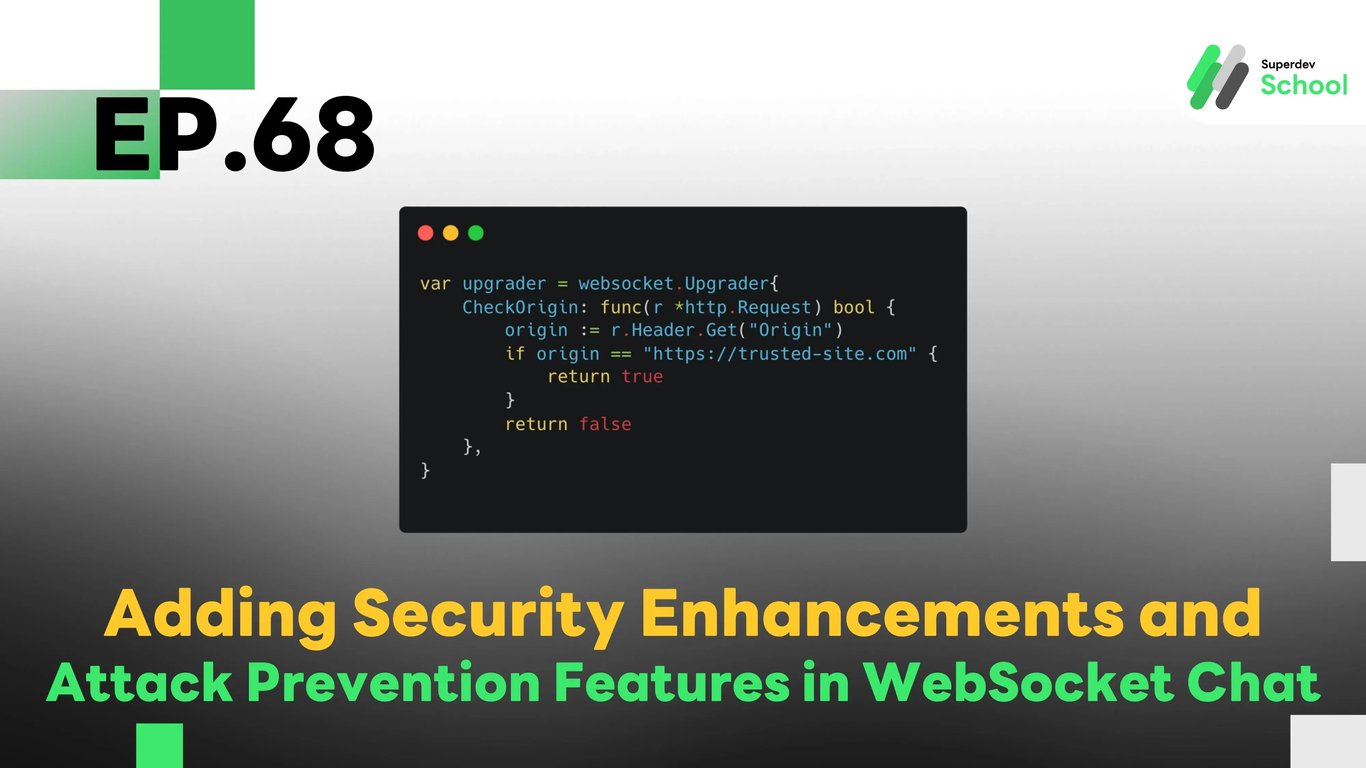
EP.68 Adding Security Enhancements and Attack Prevention Features in WebSocket Chat
#gRPC WebSocket
#WebSocket Chat API
#gRPC Go
#WebSocket real-time communication
#WebSocket Security
In EP.68, we will explore how to add security features and prevent attacks in WebSocket Chat. WebSocket is widely used for real-time communication, but it is essential to ensure that the chat environment is secure to prevent various security vulnerabilities, such as Cross-Site WebSocket Hijacking (CSWSH), Denial of Service (DoS), and Cross-Site Scripting (XSS).
While WebSocket provides efficient communication, it also opens the door to potential security issues if not handled properly. Adding security features and preventing attacks is crucial to maintaining a safe and functional chat environment.
Why do you need security enhancements and attack prevention in WebSocket Chat?
The WebSocket Chat environment is prone to different attacks, which can lead to unauthorized access, data leaks, and service disruptions. Here are the key reasons why security enhancements are important:
- Protect User Data: Secure communication ensures that messages and user data remain private and cannot be intercepted or tampered with.
- Prevent Unauthorized Access: By adding attack prevention measures, we can prevent malicious actors from gaining unauthorized access to the WebSocket server.
- Maintain Service Continuity: Ensuring that the system is protected from Denial of Service (DoS) attacks helps in maintaining availability and preventing downtime.
Benefits of Adding Security Enhancements in WebSocket Chat
- Prevents unauthorized access: Adding security layers like authentication and token validation ensures only authorized users can access the chat system.
- Protects sensitive data: Implementing encryption (SSL/TLS) protects data in transit from being intercepted or tampered with.
- Improves reliability: With enhanced security, the system becomes more resistant to various attacks like DoS, which helps in maintaining uninterrupted service.
- Compliance with standards: Security features help your system comply with data protection regulations and industry standards.
Security Features to Add in WebSocket Chat
In this section, we'll discuss the key security features to implement in your WebSocket Chat to enhance its protection and prevent attacks.
1. Secure WebSocket Communication with SSL/TLS
Using SSL/TLS encryption for WebSocket communication ensures that all data transmitted between the client and server is encrypted, preventing eavesdropping and tampering.
- Why SSL/TLS is important:
It encrypts the data sent between clients and servers, making it harder for attackers to intercept or manipulate the messages.
Example:
To enable SSL/TLS on your WebSocket Server, you can modify the WebSocket connection setup to use an encrypted wss:// connection:
package main

import (
    "log"
    "net/http"
    "github.com/gorilla/websocket"
    "crypto/tls"
)

func main() {
    // Create a secure WebSocket server
    http.HandleFunc("/ws", func(w http.ResponseWriter, r *http.Request) {
        conn, err := upgrader.Upgrade(w, r, nil)
        if err != nil {
            log.Println("Error upgrading connection:", err)
            return
        }
        defer conn.Close()
        // Handle connection
    })

    // Load SSL certificate and private key
    certFile := "server.crt"
    keyFile := "server.key"

    // Start the server with TLS
    log.Fatal(http.ListenAndServeTLS(":443", certFile, keyFile, nil))
}
2. Cross-Site WebSocket Hijacking (CSWSH) Prevention
CSWSH occurs when an attacker can establish a WebSocket connection to a victim’s WebSocket server through a malicious website. To prevent this, we need to verify the Origin Header of incoming WebSocket requests.
- Why it's important:
The Origin Header ensures that the WebSocket connection request comes from a trusted source. This helps prevent cross-site requests from untrusted websites.
Example:
You can implement this by checking the Origin header in the WebSocket request:
var upgrader = websocket.Upgrader{
    CheckOrigin: func(r *http.Request) bool {
        origin := r.Header.Get("Origin")
        if origin == "https://trusted-site.com" {
            return true
        }
        return false
    },
}
3. Token-Based Authentication (JWT)
Using JWT (JSON Web Tokens) for authentication ensures that only authenticated users can access the WebSocket server and perform actions such as sending messages.
- Why JWT is important:
It allows the server to authenticate users securely and verify that the user making the WebSocket request is authorized to do so.
Example:
package main

import (
    "github.com/dgrijalva/jwt-go"
    "time"
    "log"
    "fmt"
)

var mySigningKey = []byte("secret")

func GenerateJWT(userID string) (string, error) {
    claims := jwt.MapClaims{
        "user_id": userID,
        "exp":     time.Now().Add(time.Hour * 72).Unix(),
    }

    token := jwt.NewWithClaims(jwt.SigningMethodHS256, claims)
    tokenString, err := token.SignedString(mySigningKey)
    if err != nil {
        return "", err
    }

    return tokenString, nil
}

func main() {
    token, err := GenerateJWT("user123")
    if err != nil {
        log.Fatal("Error generating JWT:", err)
    }
    fmt.Println("Generated JWT:", token)
}
4. Denial of Service (DoS) Prevention
To protect your WebSocket server from DoS attacks, you should limit the number of connections from a single IP and also throttle message sending to prevent spamming.
- Why DoS protection is important:
It prevents an attacker from overloading the server with requests, which can cause it to become unresponsive.
Example:
You can set a maximum number of connections per IP and limit the rate at which a client can send messages:
package main

import (
    "time"
    "sync"
)

var connectionCount = make(map[string]int)
var lock = sync.Mutex{}

func checkDoSProtection(ip string) bool {
    lock.Lock()
    defer lock.Unlock()

    if connectionCount[ip] > 5 {  // Limit connections to 5 per IP
        return false
    }
    connectionCount[ip]++
    return true
}
Testing the Security Features
Once you've implemented the security enhancements in your WebSocket Chat, it’s essential to perform testing:
- Test SSL/TLS Connection:
Verify that all connections are encrypted using SSL/TLS. - Test CSWSH Protection:
Ensure that only requests with the correct Origin Header can establish a WebSocket connection. - Test JWT Authentication:
Confirm that only users with valid JWT tokens can access the WebSocket server. - Test DoS Protection:
Test the system's ability to handle multiple connections and prevent flooding from a single IP address.
Challenge!
Try implementing message rate-limiting in WebSocket Chat to prevent spam and ensure users don’t overload the system by sending too many messages in a short period.
Next EP:
In EP.69, we will explore Using gRPC for API Development in WebSocket Chat to enhance communication between the server and client with faster, more efficient communication using gRPC!