07/06/2026 06:43am
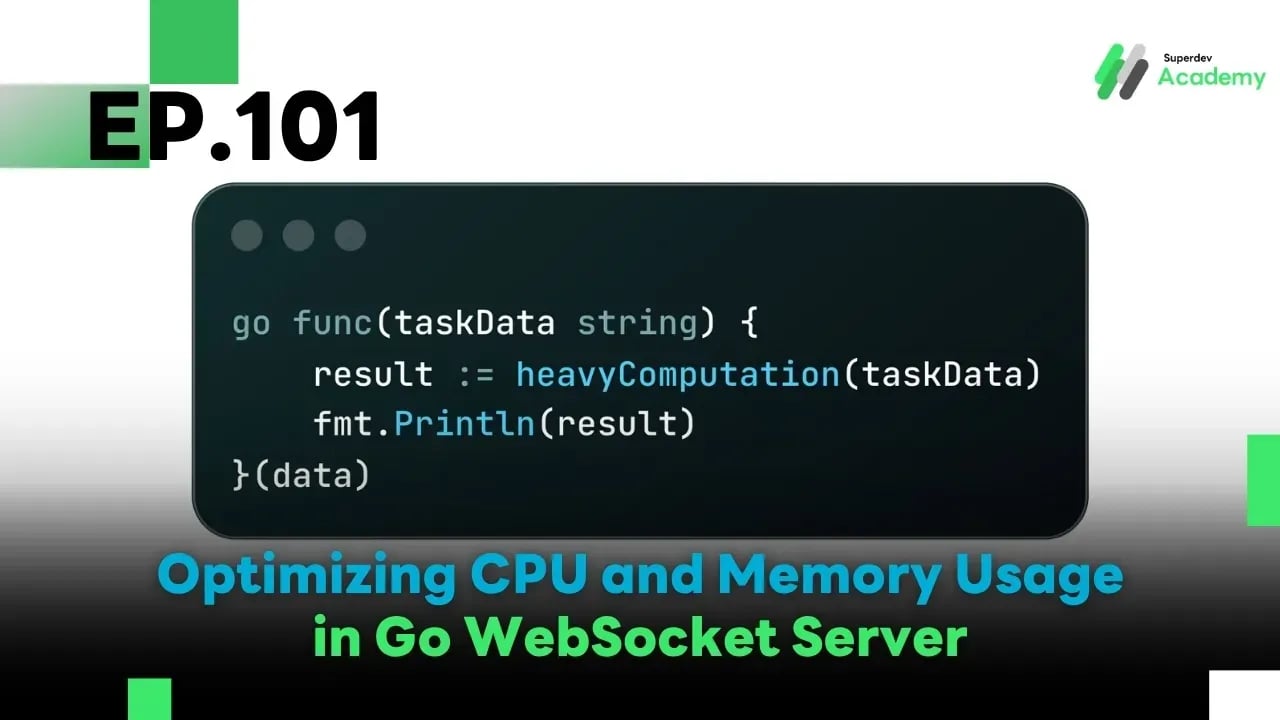
EP.101 Optimizing CPU and Memory Usage in Go WebSocket Server
#WebSocket Server
#Golang
#CPU Optimization
#Memory Management
In the world of real-time systems where thousands of users may connect concurrently, building an efficient WebSocket Server is the cornerstone of success. CPU and memory management directly affect speed, stability, and the ability to scale the system.
This article walks you through best practices for optimizing CPU and memory usage in a WebSocket Server written in Go — complete with real-world code examples and techniques ready for production deployment.
🔧 1. CPU Optimization Techniques
🧠 Offload CPU-bound Tasks from the Main Thread
Heavy operations such as encryption, large JSON processing, or deep data computation should be run in separate Goroutines to avoid blocking the main WebSocket loop:
go func(taskData string) {
    result := heavyComputation(taskData)
    fmt.Println(result)
}(data)
🚫 Avoid Blocking Operations
- Never do long-running I/O or blocking operations on the main thread.
- Use
select {}with timeouts to prevent infinite wait loops.
📊 Use Go pprof to Profile CPU Usage
- Run an embedded pprof server in your Go application.
- Analyze hot paths and CPU bottlenecks.
💾 2. Memory Optimization Techniques
✅ Use Optimized Data Structures
Avoid unnecessarily deep struct nesting and use explicit-type maps:
var clients = make(map[*websocket.Conn]*Client)
🧹 Prevent Memory Leaks
- Properly close unused connections:
conn.Close() - Remove client entries from the map upon disconnection.
📨 Use Buffered Channels for Queues
Buffered channels prevent blocking and reduce unnecessary memory allocations:
eventQueue := make(chan Event, 100)
📋 3. Best Practices
🧩 Tune GOMAXPROCS
Set the number of CPU cores for maximum concurrency:
runtime.GOMAXPROCS(runtime.NumCPU())
📦 Use Buffer Pools to Reduce Allocations
Avoid frequent memory allocation by reusing buffers:
var bufferPool = sync.Pool{
    New: func() interface{} {
        return new(bytes.Buffer)
    },
}
🔎 Detect Memory Leaks with pprof
Use go tool pprof to inspect heap usage and track unreleased objects.
📈 4. Benchmarking & Performance Monitoring
🔥 Load Testing Tools
| Tool | Highlights |
|---|---|
| hey | Simple, perfect for HTTP benchmarking |
| wrk | Scripting support and custom headers |
| Gatling | Simulates complex load scenarios |
| Artillery | WebSocket support out of the box |
🧪 Real-time Monitoring
Use Prometheus + Grafana to monitor:
- CPU, Memory, Network I/O, Latency
- Concurrent connections under load
🎯 Challenge for You
Try applying these techniques to prepare your WebSocket server for real-world traffic:
✅ Move CPU-heavy tasks to Goroutines
✅ Profile and fix CPU bottlenecks using pprof
✅ Use buffered channels and typed maps for client management
✅ Monitor memory leaks during user connection/disconnection
✅ Run a load test with 1,000 concurrent WebSocket connections using Artillery
Can your server handle the pressure? 💪
🧠 Summary
A Go-based WebSocket Server can scale to thousands of users — if you manage CPU and memory properly. Key techniques include:
- Isolating heavy tasks from the main loop
- Tuning
GOMAXPROCSto match CPU cores - Profiling memory and CPU usage with standard tools
- Reducing allocations using buffer pools
These are the building blocks for a production-grade, high-performance real-time system.
🔜 Next EP:
EP.102 – Using Goroutines and Worker Pools to Handle Concurrent Connections
In the next episode, we’ll dive deeper into creating efficient Goroutine management and building a scalable Worker Pool to handle thousands of users without breaking under pressure.
Stay tuned — we’re just getting started! 🚀
Read more
🔵 Facebook: Superdev Academy
🔴 YouTube: Superdev Academy
📸 Instagram: Superdev Academy
🎬 TikTok: https://www.tiktok.com/@superdevacademy?lang=th-TH
🌐 Website: https://www.superdevacademy.com/en