07/06/2026 06:43am
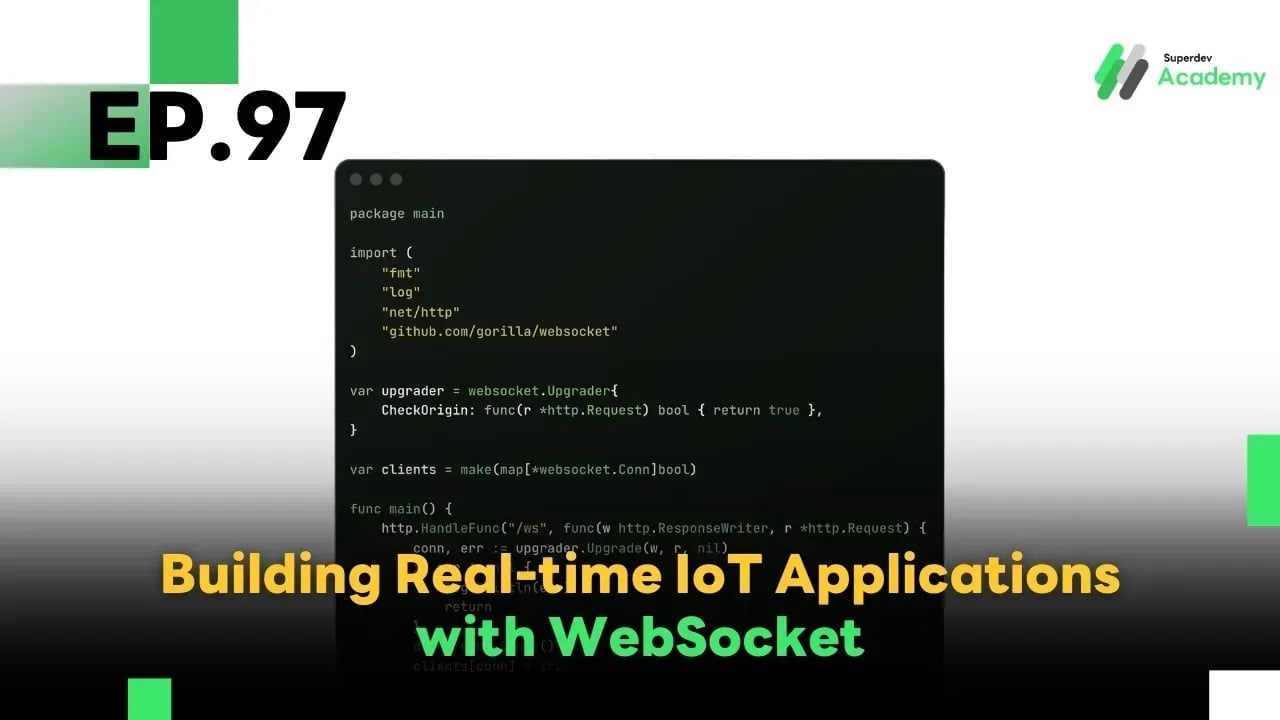
EP.97 Building Real-time IoT Applications with WebSocket
#Real-Time Communication
#Golang
#WebSocket
#IoT
#websocket server for devices
In developing IoT applications that require real-time communication, WebSocket is a powerful solution. It offers low-latency and bi-directional communication, making it ideal for transmitting data instantly between multiple IoT devices and a server.
1. Connecting IoT Devices to a WebSocket Server
🔌 Each IoT device establishes and maintains a WebSocket connection to the server to continuously send and receive data.
🧠 Example server-side code in Go:
package main

import (
    "fmt"
    "log"
    "net/http"
    "github.com/gorilla/websocket"
)

var upgrader = websocket.Upgrader{
    CheckOrigin: func(r *http.Request) bool { return true },
}

var clients = make(map[*websocket.Conn]bool)

func main() {
    http.HandleFunc("/ws", func(w http.ResponseWriter, r *http.Request) {
        conn, err := upgrader.Upgrade(w, r, nil)
        if err != nil {
            log.Println(err)
            return
        }
        defer conn.Close()
        clients[conn] = true

        for {
            _, msg, err := conn.ReadMessage()
            if err != nil {
                log.Println("Read error:", err)
                delete(clients, conn)
                break
            }
            fmt.Printf("Received from device: %s\n", msg)
        }
    })

    log.Println("IoT WebSocket Server running on :8080")
    http.ListenAndServe(":8080", nil)
}
2. Efficient Bandwidth Management
📉 Sending data from thousands of devices can overwhelm the network if not properly optimized.
✅ Use delta updates instead of sending full data payloads every time
✅ Use binary formats like Protobuf or MsgPack to reduce message size
✅ Set proper update intervals (e.g., every 1–5 seconds for sensors)
3. Security & Device Authentication
🔒 To ensure secure connections, data must be encrypted and devices should be authenticated before communication.
✅ Use TLS/WSS (wss://) to protect data in transit
✅ Verify authentication tokens or API keys on every connection
token := r.URL.Query().Get("token")
if !validateToken(token) {
    http.Error(w, "Unauthorized", http.StatusUnauthorized)
    return
}
✅ Protect against man-in-the-middle attacks and unauthorized access
4. Managing Thousands of Devices
When dealing with thousands of devices, the architecture must efficiently manage connections.
✅ Store device connections in a map using unique device IDs
✅ Use room/topic-based messaging for group communication
✅ For multi-instance systems, use Redis Pub/Sub to synchronize device states across servers
5. Best Practices for IoT with WebSocket
🛠️ Key tips to ensure stability and scalability:
✅ Monitor device connections and send heartbeat messages regularly
✅ Implement reconnect and retry logic
✅ Apply rate limits to avoid server overload
✅ Test latency and throughput under real-world load
🎯 Developer Challenge Before the Next EP:
Try these with your own IoT system:
✅ Connect 10+ devices to your WebSocket server
✅ Send delta sensor updates every 2 seconds
✅ Authenticate each device using an API token
✅ Monitor connection health and implement Redis Pub/Sub
Then measure the latency, stability, and resource usage in production!
🚀 Summary
Using WebSocket for IoT gives you the ability to:
✅ Handle thousands of simultaneous connections
✅ Enable real-time, efficient data exchange
✅ Ensure secure communication with encryption and auth
✅ Optimize bandwidth usage with smart data handling
🔜 Next EP (EP.98):
Using WebSocket with Blockchain for Real-time Data Streams
Learn how to integrate WebSocket with blockchain systems to track transactions and events instantly with real-time updates.
Ready to build an IoT system that speaks to the world in real time? Let’s go! 🌍📡
Read more
🔵 Facebook: Superdev Academy
🔴 YouTube: Superdev Academy
📸 Instagram: Superdev Academy
🎬 TikTok: https://www.tiktok.com/@superdevacademy?lang=th-TH
🌐 Website: https://www.superdevacademy.com/en