07/06/2026 06:43am
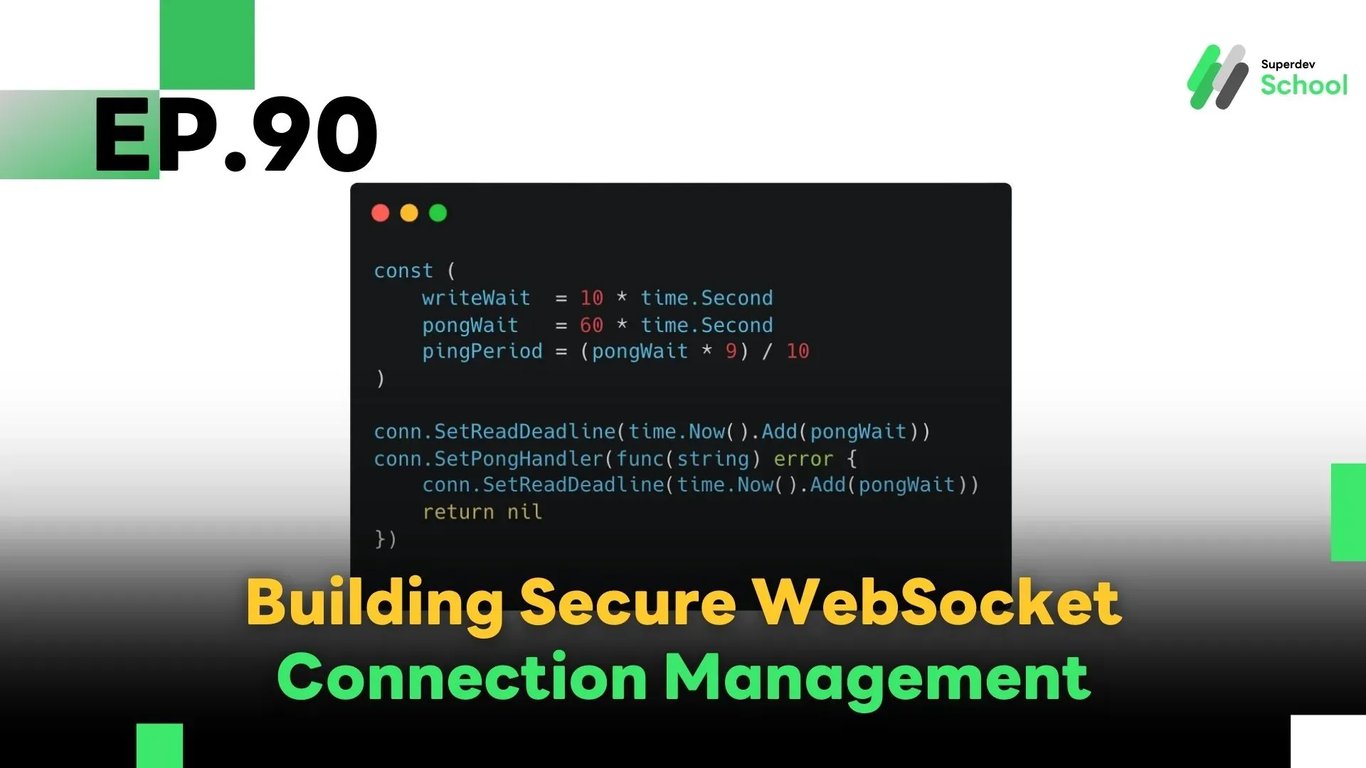
EP.90 Building Secure WebSocket Connection Management (Secure Connection Management)
#WebSocket
#Golang
#Go
#Secure Connection
When developing a WebSocket server for real-time applications—such as chat systems, multiplayer games, or live notifications—secure and efficient connection management becomes the backbone of system stability, security, and scalability.
This article walks you through practical approaches to building a secure WebSocket connection management system using Go, suitable for real-world production environments.
⏱ Setting Timeouts for Connections
To prevent stale connections and detect silent disconnections, it's essential to set appropriate timeouts:
- Ping/Pong Interval: Helps verify that the client is still responsive.
- Idle Timeout: If the client does not respond to a
pongor remains inactive for a specified duration, the server should close the connection.
Example in Go (using gorilla/websocket):
const (
    writeWait  = 10 * time.Second
    pongWait   = 60 * time.Second
    pingPeriod = (pongWait * 9) / 10
)

conn.SetReadDeadline(time.Now().Add(pongWait))
conn.SetPongHandler(func(string) error {
    conn.SetReadDeadline(time.Now().Add(pongWait))
    return nil
})
🔍 Detecting Disconnections
To detect when a client has dropped out, use the following techniques:
- Send regular heartbeat messages using ping/pong.
- Maintain a connection map or store session data in Redis for multi-instance environments.
- Implement a cleanup routine to remove inactive connections.
🔐 Preventing WebSocket Hijacking
WebSocket hijacking is a serious security concern where attackers attempt to hijack an open connection. Here’s how to prevent it:
✅ Validate the Origin header to ensure the request is coming from a trusted domain.
✅ Always use wss:// (TLS) to encrypt data in transit.
✅ Require authentication before upgrading to WebSocket (e.g., via JWT or OAuth2).
Example of checking origin in Go:
upgrader := websocket.Upgrader{
    CheckOrigin: func(r *http.Request) bool {
        return r.Header.Get("Origin") == "https://yourdomain.com"
    },
}
🌐 Managing Multi-instance Connections (Horizontal Scaling)
When your system spans multiple WebSocket servers (e.g., behind a load balancer or on Kubernetes), you need to synchronize connection states across instances.
- Use Redis Pub/Sub, NATS, or other message brokers to relay messages across instances.
- Design your architecture with horizontal scalability in mind from the start.
✅ Best Practices Checklist
- 🔌 Terminate idle or unresponsive connections after the timeout.
- 📝 Log every connection, disconnection, and error.
- 🧪 Perform regular load testing to ensure real-world stability.
- ⚙️ Adjust timeouts based on actual use cases (e.g., 1–2 minutes for chat, shorter for games).
- 🔒 Use TLS (wss://) in all production deployments to ensure data security.
🔐 Summary
A well-designed connection management system =
Stable connections + Strong security + Future-ready scalability
By following these best practices, you’ll ensure that your WebSocket server can perform reliably even under high loads and across complex real-world scenarios.
🔜 Next EP.91:
“Building WebSocket Servers for Multi-Time Zone Connectivity”
Learn how to design a real-time system that can serve users across different countries and time zones with accurate, synchronized communication.
Read more
🔵 Facebook: Superdev School (Superdev)
📸 Instagram: superdevschool
🎬 TikTok: superdevschool
🌐 Website: www.superdev.school