18/08/2026 21:17pm

What is Daybreak? The Secret Weapon for Developers in 2026
#GPT-5.5-Cyber
#OpenAI Daybreak
#AI-Native Security
#Cyber Defense for Developers
#Automated Patching
#SuperDev Academy
Imagine this You’re fast asleep after a smooth evening deployment. Suddenly, a critical Zero day vulnerability is discovered and attacks begin spreading across servers globally. In the old world this meant an urgent on call page hours of frantic log combing to find the culprit line desperate attempts to code a fix and the gut wrenching prayer that your patch doesn't break the entire system. But here in 2026... it’s time to forget that nightmare.
Just days ago OpenAI sent shockwaves through the cybersecurity industry once again with the launch of Daybreak. This proactive initiative is being hailed as the dawn for developers. The name isn't just marketing fluff it was specifically designed to end the era of playing catch up with hackers and transform us into proactive strategists who stay ahead of the risk.
Daybreak isn't just an AI that helps you write code it is a First Responder that neutralizes threats before a human even realizes they exist. This definition perfectly captures its essence.
For us developers Daybreak represents a monumental shift. It’s not just another tool in the stack it’s a fundamental transformation of our workflow moving from a Reactive stance to one of Resilience baked in from the very first line of code we write.
What is Daybreak?
To put it simply, Daybreak isn't just a chat window where you copy paste code and ask Are there any bugs? It is the result of taking a top tier model like GPT 5.5 and applying Specialized Fine tuning to create a new breed: GPT 5.5 Cyber.
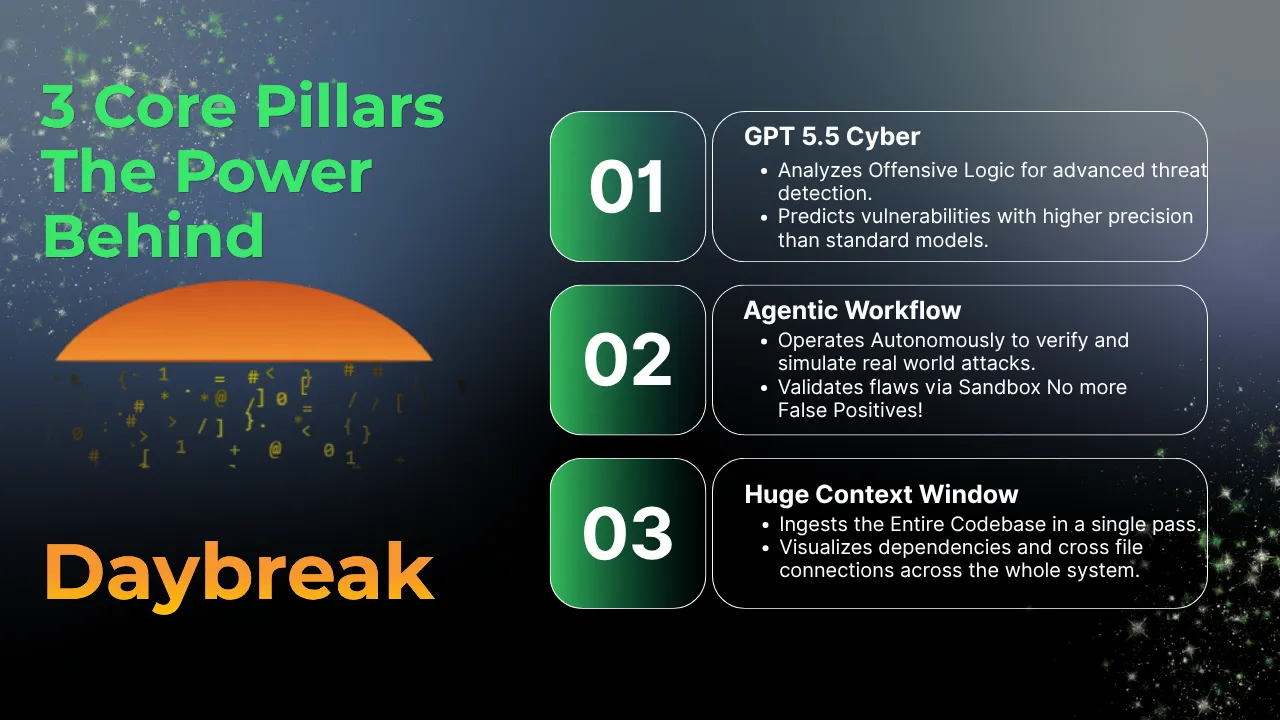
The power behind Daybreak rests on three core pillars:
GPT 5.5 Cyber (The Brain): An engine trained on massive datasets of vulnerability reports (CVE), malware behaviors, and high quality global codebases. It doesn't just memorize patterns it understands Offensive Logic. This allows it to predict exactly where a hacker might strike with far greater precision than standard models.
Agentic Workflow (The Muscle): This is what sets Daybreak apart from traditional scanners its Autonomous capability. When it detects a vulnerability, it doesn't just fire off an alert. It spins up a Sandbox Instance to simulate a real attack, confirming if the flaw is actually exploitable (PoC Proof of Concept). This effectively eliminates the headache of False Positives.
Expanded Context Window: In this 2026 version OpenAI has expanded the context window so vastly that it can ingest an entire project’s codebase in one go. It sees all Dependencies and cross file connections simultaneously, rather than looking at files in isolation.
Fun Fact: The name 'Daybreak' was chosen as a subtle challenge to Anthropic’s Glasswing. The implication is clear: no matter how transparent or well hidden your wings are, everything is exposed once the light of Daybreak arrives.
Features:
Automated Patch Validation: Upon finding a flaw, Daybreak drafts a patch and runs it in a simulated environment to ensure it doesn't break the system. If it passes, it sends a Pull Request (PR) directly to you for merging.
Infrastructure as Code (IaC) Auditing: It looks beyond the logic to your Docker, Kubernetes, or Terraform configurations. It catches exposed ports or secret keys accidentally left in your environment variables.
From Hours to Minutes : Daybreak as the Team’s First Responder
In software development,Time is the ultimate enemy. The longer it takes to find a vulnerability, the more time a hacker has to exploit it. Recent data from OpenAI shows that Daybreak can reduce Vulnerability Analysis from several hours to just a few minutes by utilizing high efficiency tokens.
3 Ways Daybreak Will Transform the Way You Work:
1. Burn down the Backlog: Smart Triage Most security teams suffer from Alert Fatigue a flood of warnings where nearly half are false alarms.
The Daybreak Way: The Codex Security system validates those bugs in a sandbox immediately. If a bug is truly exploitable, it is pushed to the top of your priority list with the PoC attached, allowing you to focus on what actually matters.
2. Dependency Risk Analysis: Scanning the Extras Vulnerabilities often hide in libraries or third party packages (Supply Chain Attacks).
The Daybreak Way: Daybreak scans your entire dependency tree and builds an Editable Threat Model. It simulates how a flaw in a specific library affects your system and provides the safest path for an update or patch.
3. Patch Safely at Scale: Fixing thousands... without the fear. Security patches are delicate fixing one thing can often cause Regressions elsewhere.
The Daybreak Way: OpenAI claims Daybreak has already assisted in patching over 3,000 critical and high severity bugs worldwide. Its automated validation ensures that every patch sent is functional and safe before you ever hit Approve.
Case Study: Industry leaders like Cloudflare and Cisco have already integrated Daybreak into their CI/CD Pipelines. By auditing and repairing code during the build stage, they ensure their software is Resilient by Design from day one.
How Should Developers Adapt in the Era of Daybreak?
The arrival of Daybreak doesn't mean we’re out of a job. Instead, it’s a massive level up for coding standards. In this AI Native Security era those who adapt early are the ones who will control the game.
1. Master Agent Management Over Line by Line Coding
Since Daybreak operates on an Agentic Workflow (utilizing up to 10 sub agents within Codex Security) your value shifts from being a writer to being a Director and Auditor.
Skill Up: Dive into Prompt Engineering for Agents. Learn how to guide AI to prioritize vulnerabilities based on your specific Business Logic.
Action: Experiment with tools like Codex Skills to build reusable workflows for repetitive tasks, such as automated Regression Testing after a patch.
2. Elevate Personal Security (Phishing Resistant Security)
OpenAI has made it clear: starting June 1 2026 anyone accessing advanced models like GPT 5.5 Cyber must enable Advanced Account Security (e.g., Hardware Security Keys or Passkeys).
Action: Switch to Passwordless logins and ditch SMS OTP for critical accounts. Today’s AI is incredibly skilled at Social Engineering your traditional security habits are no longer enough.
3. Get Familiar with Editable Threat Models
Daybreak automatically generates a threat model based on your repository.
Action: When the AI delivers a Threat Model, don't just Click to Dismiss. Read it. Understand why it flagged a specific point as a risk. Treat this as a world-class security masterclass that will help you write more secure code in your next project.
4. Leverage the Trusted Access Program
If you’re working at an Enterprise level, don’t wait for the 100% Public release.
Action: Reach out through partners like Cloudflare or Cisco. These companies are among the first to integrate Daybreak into their systems, allowing you to start Vulnerability Scanning immediately.
Urgent Checklist:
[ ] Switch your logins to Passkeys / Hardware Keys.
[ ] Study the architecture of Agentic Workflows and MCP (Model Context Protocol).
[ ] Submit a request for Trusted Access for your organization.
Frequently Asked Questions about Daybreak (FAQ)
Whenever groundbreaking technology emerges, questions regarding safety and ethics are inevitable. Here are the top concerns being discussed in the developer community:
Q: What if hackers get their hands on GPT 5.5 Cyber? Won't we be under a more massive assault than ever?
A: That is an excellent question, and OpenAI has anticipated this. They have implemented a rigorous Trusted Access Only system. Accessing Offensive (Red Teaming) capabilities requires enterprise-level verification and a clearly defined use case. Furthermore, the model itself is equipped with Safety Guardrails designed to refuse the generation of attack code if the target is not an authorized system.
Q: Will Daybreak replace security teams entirely?
A: It’s not a replacement it’s an upgrade. Tedious, routine tasks like sifting through logs or identifying basic bugs will be handled by AI. This allows human experts to transition into roles like Security Architects or high level strategists. These roles require business intuition and creative problem solving that AI simply cannot replicate.
The launch of OpenAI Daybreak in May 2026 is a clear signal that the world of software development has fundamentally shifted. We are entering an era where Security is not an option, but a default.
From this point forward, the phrase I'll fix that bug later will slowly disappear. We now have an AI partner capable of suggesting fixes the moment we type the code. Daybreak doesn't want us to be less skilled; it wants us to go further and stay safer. The tech world waits for no one. Daybreak is your chance to upgrade yourself into a next-gen developer: Cutting-edge, clear-headed, and practical.
How about you? Are you ready to embrace the first light of Daybreak? Or will you wait until your system is breached before making your move?
Follow Superdev Academy on all platforms:
🔵 Facebook: Superdev Academy Thailand
🎬 YouTube: Superdev Academy Channel
📸 Instagram: @superdevacademy
🎬 TikTok: @superdevacademy
🌐 Website: superdevacademy.com