14/10/2026 10:34am

Why Become a Software Developer? An In-Depth Guide to a Thriving Tech Career | Superdev Academy
#What is a Developer
#Software Developer Career
#Developer Responsibilities
#Front-End Developer
#Back-End Developer
#Full-Stack Developer
#DevOps Engineer
#Why Become a Developer
#learn programming
#SuperDev Academy
Ever wonder why so many professionals are making the transition into software development?
Being a software developer is more than just writing lines of code on a screen—it is one of the most dynamic, high-impact careers in the modern economy. This guide breaks down what developers actually do, the primary career tracks, and why investing in software engineering skills offers long-term value.
What is a Developer?
At its core, a software developer is a systematic problem solver who uses programming languages as tools to build functional digital systems.
Developers take business requirements and user needs, transforming them into executable instructions for computers. Whether it is a mobile application, an e-commerce platform, or high-throughput backend infrastructure, every digital product relies on logical architecture designed by developers
What Does a Developer Do?
Writing code is only one phase of the role. A software developer's responsibilities cover the entire software development lifecycle:
Analysis & Design: Collaborating with product managers and UI/UX designers to define system behavior, feature specifications, and technical feasibility.
Implementation (Coding): Writing clean, maintainable code using programming languages, frameworks, and libraries suited for the project.
Testing & Quality Assurance: Identifying and fixing bugs, writing automated unit and integration tests, and ensuring system reliability under real-world conditions.
Maintenance & Optimization: Monitoring production environments, refactoring legacy systems, and shipping continuous feature updates.
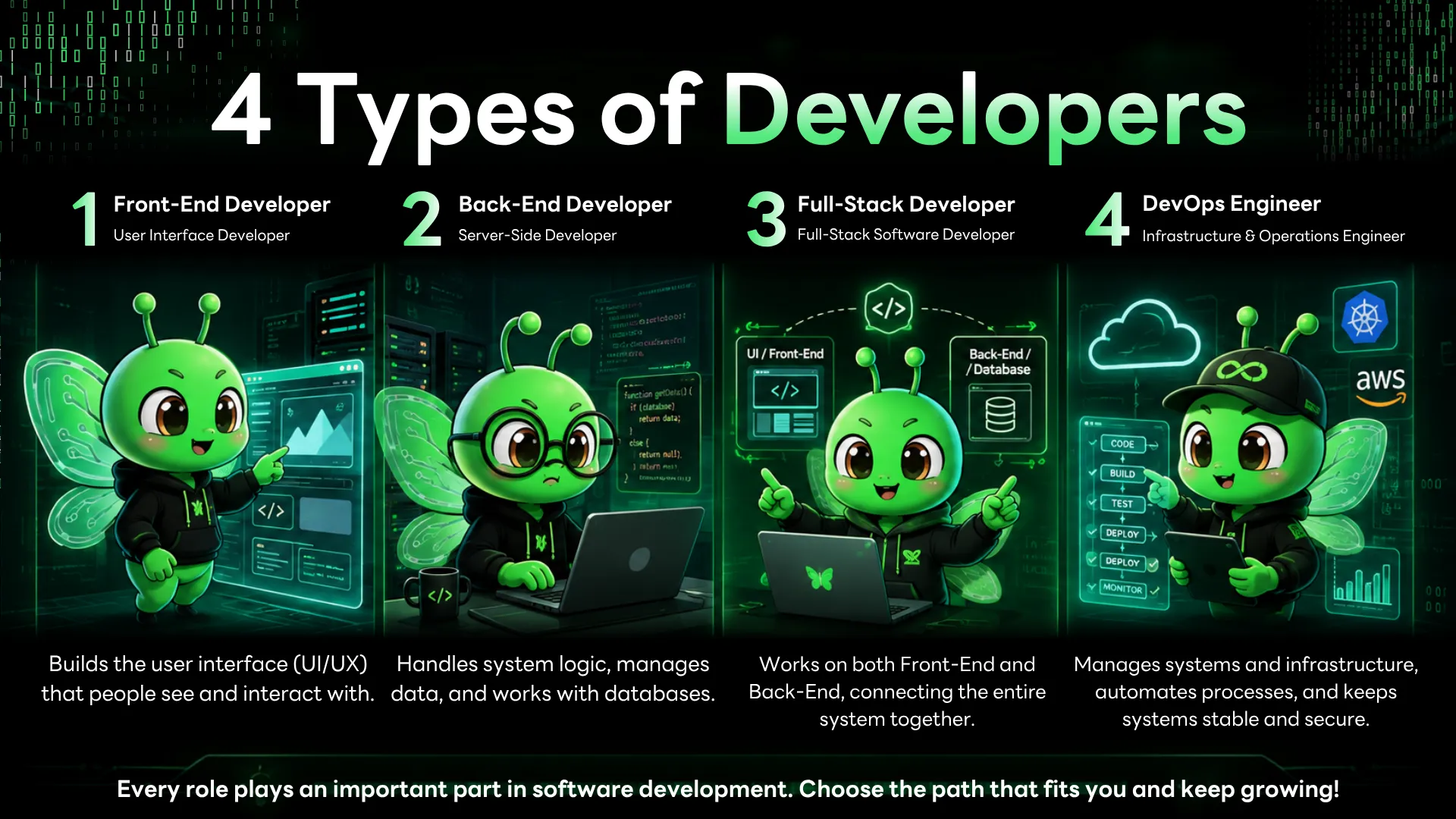
Types of Developers
Software engineering is divided into specialized roles to ensure end-to-end system reliability and efficiency:
1. Front-End Developer (User Interface Specialist)
Responsible for building the user interface (UI) and user experience (UX) across web and mobile platforms. Front-end engineers convert design mockups into interactive, responsive digital products that render smoothly across all device sizes.
Core Responsibilities: Building dynamic layouts, managing client-side state, optimizing page performance, and integrating REST or GraphQL APIs from the backend.
Primary Technologies: HTML5, CSS3, JavaScript/TypeScript, alongside modern frameworks like React, Vue.js, or Angular.
2. Back-End Developer (Server-Side Specialist)
Focuses on server-side architecture, core business logic, database management, and system security. While their work is hidden from the end user, back-end infrastructure handles critical operations like authentication, payment processing, and data persistence.
Core Responsibilities: Designing APIs (RESTful, gRPC), architecting database schemas, managing authentication/authorization flows, and tuning query performance.
Primary Technologies: Go (Golang), Python, Node.js, Java, paired with relational (PostgreSQL, MySQL) and NoSQL databases (MongoDB, Redis).
3. Full-Stack Developer (End-to-End Specialist)
Handles both front-end user interfaces and back-end server architecture. Full-stack engineers understand end-to-end software delivery, making them key assets for startups, lean product teams, or fast-paced development environments.
Core Responsibilities: Architecting complete feature sets, building seamless API connections between client and server, and managing database integrations.
Primary Technologies: A balanced stack combining front-end and back-end tools (e.g., React + Go/Node.js + PostgreSQL).
4. DevOps Engineer (Infrastructure Specialist)
Bridges the gap between software development (Dev) and IT operations (Ops). DevOps engineers automate the software delivery pipeline and manage cloud infrastructure to ensure applications are deployed quickly, securely, and reliably at scale.
Core Responsibilities: Building CI/CD pipelines, managing cloud resources, setting up monitoring and logging systems, and configuring auto-scaling infrastructure.
Primary Technologies: Docker, Kubernetes, cloud platforms (AWS, Google Cloud, Azure), and CI/CD tools (GitHub Actions, GitLab CI).
Why Become a Developer?
Choosing a career in software development provides distinct structural advantages and long-term professional growth:
1. Strong Market Demand and Career Progression
Every industry relies on software to scale operations, keeping demand for skilled engineers consistently high. This supply-demand balance results in competitive entry-level compensation, rapid salary scaling, and clear paths for technical or managerial advancement.
2. High Business Impact and Measurable Results
Developers turn abstract requirements into tangible software used by thousands or millions of people. Solving complex architectural challenges and streamlining workflows provides immediate feedback and continuous mental growth.
3. Autonomy and Workplace Flexibility
Because software engineering output is measured by code quality and delivery milestones (managed through Git and agile boards), the field leads in remote and hybrid work models (Work from Anywhere). Engineers also benefit from a global open-source community that accelerates learning.
4. Merit-Based Evaluation and Portfolio Value
The tech industry prioritizes practical problem-solving ability over formal credentials. A strong GitHub portfolio showcasing clean architecture and production-ready code opens doors at top technology companies regardless of academic background. Furthermore, the logical thinking developed through engineering translates directly into system design, leadership, and entrepreneurship.
Career Path & Salary Benchmark
Software engineering offers a structured career progression with clear salary growth based on skills, impact, and system ownership:
1. Junior Developer (0 - 2 Years Exp)
Estimated Salary: 25,000 - 45,000+ THB / month ($800 - $1,300+ USD)
Scope & Focus: Focuses on learning codebase fundamentals, implementing specified feature tickets, fixing minor bugs, and working under senior guidance. Priorities include writing clean standard code and understanding Git version control.
2. Mid-Level Developer (2 - 5 Years Exp)
Estimated Salary: 45,000 - 80,000+ THB / month ($1,300 - $2,300+ USD)
Scope & Focus: Takes end-to-end ownership of new features, designs basic data models, and participates in code reviews. Priorities shift toward software architecture, system scalability, and security best practices.
3. Senior Developer / Tech Lead (5+ Years Exp)
Estimated Salary: 80,000 - 150,000++ THB / month ($2,300 - $4,300++ USD)
Scope & Focus: Architecting core system infrastructure, selecting tech stacks, resolving complex technical bottlenecks, and mentoring team members. Priorities include strategic communication, project management, and aligning technology choices with business goals.
4. Advanced Career Tracks
Upon reaching Senior level, developers typically choose between two specialized career tracks:
Individual Contributor (IC) Track: Deep technical specialization without people management (e.g., Staff Engineer, Principal Engineer, Software Architect) — Salary range: 150,000 - 250,000++ THB / month ($4,300 - $7,000+ USD).
Management Track: Team leadership and engineering operations (e.g., Engineering Manager, Head of Engineering, CTO) — Salary range: 150,000 - 300,000++ THB / month ($4,300 - $8,500+ USD).
Summary
Being a developer is more than just typing code all day—it is about being a creator who turns ideas into reality through a computer screen. While this journey requires patience, trial and error, and continuous learning, the rewards—competitive compensation, schedule flexibility, and pride in your work—are well worth the effort.
If you read this and feel that "this is the path for me," take that first step. Programming is never beyond your reach if you are willing to put in the effort!
Follow Superdev Academy on all platforms:
🔵 Facebook: Superdev Academy Thailand
🎬 YouTube: Superdev Academy Channel
📸 Instagram: @superdevacademy
🎬 TikTok: @superdevacademy
FAQ: Frequently Asked Questions about This Article
A collection of questions and answers to help you better understand the content of this article.