07/06/2026 06:44am
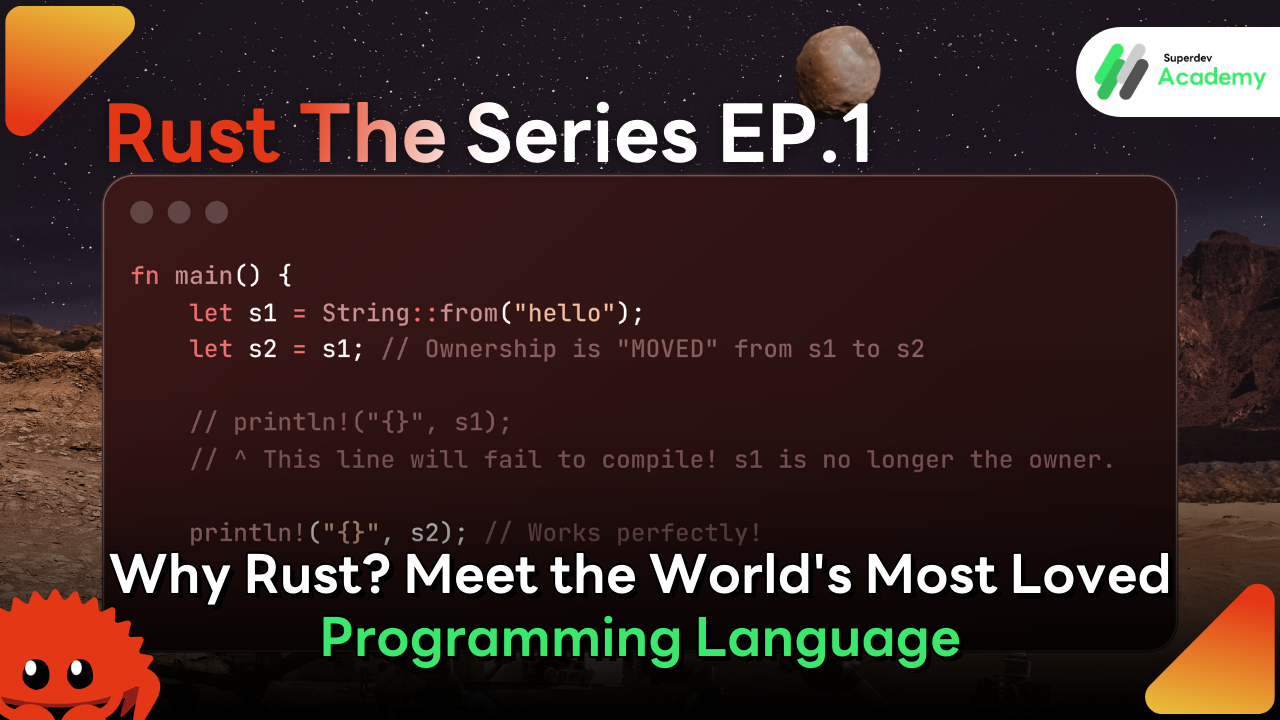
Why Rust? Meet the World's Most Loved Programming Language | Rust The Series EP.1
#Rust Programming
#Rust
#Why Rust
#memory safety
#Ownership and Borrowing
#Superdev Academy
Welcome to Rust The Series by Superdev Academy! This series is designed to take you on a deep dive into the world of Rust—from a complete beginner to deploying robust, high-performance systems in global production environments.
If you’ve been following the tech world over the past few years, the name "Rust" has likely crossed your radar. If you look at the Stack Overflow Developer Survey, you’ll find something truly remarkable: Rust has been voted the "Most Loved Programming Language" for nearly 10 consecutive years!
But why would a language known for being "hard to learn" and having the "strictest compiler" become the darling of the industry? Today, we are going to find out.
The Origin Story: A Broken Elevator 🛗
Did you know that Rust’s journey began not in a corporate boardroom, but on a staircase? In 2006, Graydon Hoare (then a Mozilla employee) returned to his apartment only to find the elevator out of service. He had to climb 21 flights of stairs.
Fuming with frustration, he discovered the frequent breakdowns were caused by software memory bugs in a system written in C++. That exhausting climb sparked an idea: to create a new language that is "as fast as C++ but 100% safe from memory-related bugs." That was the birth of Rust.
Fun Fact: Contrary to popular belief, the name "Rust" doesn't come from oxidized metal. Graydon named it after the "Rust Fungus"—a biological organism that is incredibly resilient, persistent, and hard to kill. This perfectly reflects the language’s philosophy of safety and durability.
3 Pillars: Why the World Loves Rust
Why are global giants rewriting their legacy systems in Rust? Here are the core reasons:
1. Blazing Fast Performance 🚀
Unlike Java, C#, or Go, Rust has no Garbage Collector (GC) running in the background. This means there are no unpredictable latency spikes during execution. Your code is compiled directly into machine code, ensuring minimal resource consumption (RAM/CPU) at a level equivalent to C and C++.
Furthermore, Rust features "Zero-Cost Abstractions." This allows you to write elegant, high-level code without sacrificing performance. You get the best of both worlds: developer-friendly syntax and low-level speed.
2. Memory Safety Above All 🛡️
In C/C++, developers have manual control over memory, which often leads to critical vulnerabilities like Null Pointer Dereferencing or Memory Leaks.
Rust eliminates these issues through a revolutionary system called Ownership & Borrowing. This acts as a strict set of "laws" enforced by the compiler. If your code isn't safe, the compiler will catch it immediately and refuse to build.
Let's look at a classic "Ownership" example that often trips up beginners:
Rust
fn main() {
    let s1 = String::from("hello");
    let s2 = s1; // Ownership is "MOVED" from s1 to s2

    // println!("{}", s1);
    // ^ This line will fail to compile! s1 is no longer the owner.

    println!("{}", s2); // Works perfectly!
}
By being "picky," the Rust compiler ensures you don't have to wake up at 2 AM to fix a production server crash caused by memory corruption.
3. Fearless Concurrency 🧵
Multi-threaded programming is notoriously difficult because of Data Races (when multiple threads modify the same data simultaneously, causing corruption). Rust’s Ownership rules allow the compiler to track data access across threads. It literally prevents data races at compile time, giving you the confidence to squeeze every ounce of power from multi-core CPUs without the fear of breaking things.
Who Uses Rust in Production?
It’s no longer just for "indie" projects. The tech titans have fully embraced Rust:
Linux Kernel: For the first time in over 30 years, Rust was accepted as the second official language (alongside C) for writing Linux kernel code.
Discord: Migrated their "Read States" service from Go to Rust to solve latency spikes caused by Go’s Garbage Collector. The result? A smoother experience and significantly lower RAM usage.
AWS: Built Firecracker (the microVM technology behind AWS Lambda and Fargate) using Rust for high security and blazing-fast Cold Boot times (under 125ms).
Cloudflare: Developed "Pingora" (their core HTTP proxy) in Rust to replace NGINX, handling over 35 million requests per second with extreme safety.
Performance Benchmark (JSON Encoding)
Language | Memory Usage (RAM) | Relative Speed |
Rust | ~41 MB | Fastest (1.0x) |
Go | ~132 MB | 1.5x - 2x Slower |
Python | ~160 MB+ | Up to 50x Slower |
Conclusion
Rust is not just a passing fad; it is an elevation of programming standards. It successfully marries maximum speed with maximum safety. While the learning curve might be steep for the first couple of months, over 85% of developers report feeling significantly more confident in the correctness of their code compared to any other language.
In EP.2 (Coming Soon): We’re moving from theory to practice! I’ll show you how to Equip Your Arsenal: from installing Rustup, mastering Cargo, to optimizing VS Code (+ rust-analyzer) or RustRover into the ultimate environment for a Rustacean.
Get your computers ready, and I’ll see you in the next episode!
🎯 Stay Tuned with Superdev Academy:
Don't miss out on deep-dive technical articles and updates. Follow us on all platforms:
🔵 Facebook: Superdev Academy Thailand
🎬 YouTube: Superdev Academy Channel
📸 Instagram: @superdevacademy
🎬 TikTok: @superdevacademy
🌐 Website: superdevacademy.com