07/06/2026 06:42am
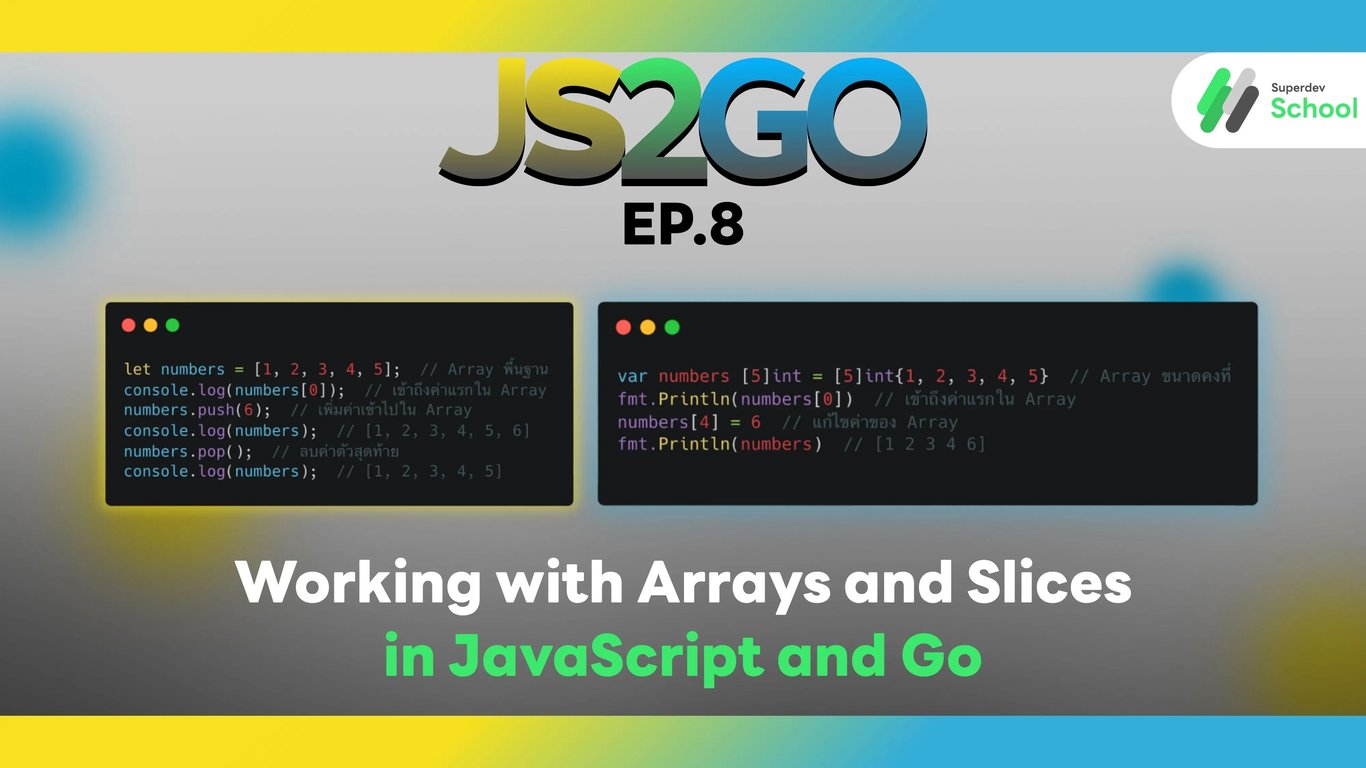
JS2GO EP.8 Working with Arrays and Slices in JavaScript and Go
#JavaScript
#Go
#Arrays
#Slices
#JavaScript vs Go
#Differences between Go and JavaScript
In this article, we will explore Arrays and Slices in JavaScript and Go, comparing how they are used in both languages. These two types are used for storing multiple values in a single data structure, but they are used differently in each language.
Working with Arrays in JavaScript and Go
JavaScript:
In JavaScript, Arrays are used to store multiple values of different types in a single sequence, and they can be dynamically resized at runtime.
Declaring and Using Arrays:
let numbers = [1, 2, 3, 4, 5];  // Basic Array
console.log(numbers[0]);  // Accessing the first element of the array
numbers.push(6);  // Adding a value to the array
console.log(numbers);  // [1, 2, 3, 4, 5, 6]
numbers.pop();  // Removing the last value
console.log(numbers);  // [1, 2, 3, 4, 5]
Explanation:
- In JavaScript, an Array can store multiple types of data and supports dynamic resizing. Methods like
push(),pop(),shift(), andunshift()make it easy to manipulate the array.
Go:
In Go, Arrays have a fixed size that must be defined when the array is declared, and the size cannot be changed afterward.
Declaring and Using Arrays:
var numbers [5]int = [5]int{1, 2, 3, 4, 5}  // Fixed-size Array
fmt.Println(numbers[0])  // Accessing the first element of the array
numbers[4] = 6  // Modifying a value in the array
fmt.Println(numbers)  // [1 2 3 4 6]
Explanation:
- In Go, arrays require the size to be specified when declared, and this size cannot be changed afterward. To work with dynamic data sizes, Slices are used.
Working with Slices in JavaScript and Go
JavaScript:
In JavaScript, Arrays can be used as Slices because Arrays are dynamic and can grow or shrink in size as needed.
Working with Subarrays (like Slices):
let numbers = [1, 2, 3, 4, 5];
let slice = numbers.slice(1, 4);  // Creating a slice from index 1 to 3
console.log(slice);  // [2, 3, 4]
Explanation:
- JavaScript uses Arrays to function as Slices. You can use the
slice()method to create a subarray (or slice) of an existing array, which is similar to Slices in Go.
Go:
In Go, Slices are more flexible than Arrays because they can dynamically resize during runtime, and they are often used for working with data whose size is not known in advance.
Declaring and Using Slices:
numbers := []int{1, 2, 3, 4, 5}  // Slice without predefined size
fmt.Println(numbers[1:4])  // Slice from index 1 to 3
numbers = append(numbers, 6)  // Adding a value to the slice
fmt.Println(numbers)  // [1 2 3 4 5 6]
Explanation:
- In Go, Slices are used instead of Arrays for flexible resizing. The
append()function is used to add values to the slice.
Pros and Cons of Using Arrays and Slices
JavaScript:
- Pros:
- Arrays in JavaScript can grow and shrink in size dynamically.
- Methods like
push()andpop()make it easy to add or remove data from arrays.
- Cons:
- Arrays in JavaScript can be inefficient for handling large datasets or performing complex operations such as sorting and searching on large arrays.
- Array performance may degrade as the size increases, especially with large amounts of data.
Go:
- Pros:
- Slices in Go are flexible and can dynamically resize as needed.
- Go prefers Slices for handling data of unknown size, providing both flexibility and efficiency.
- Cons:
- Arrays in Go have a fixed size, which makes them less suitable for situations where the size of the dataset changes frequently.
- Working with Slices may require extra memory management, especially when resizing or appending elements.
Summary and Recommendations:
- JavaScript uses Arrays, which are dynamically sized and well-suited for web applications that need flexibility when handling ordered data.
- Go uses both Arrays and Slices, with Slices providing the flexibility required to handle dynamic data sizes. Slices are highly recommended for most use cases, while Arrays are best for fixed-size collections.
If you are looking to develop web applications that require flexible data management, JavaScript is a great choice. However, if performance is crucial and your project involves managing dynamically sized data efficiently, Go and its Slice functionality are more appropriate.
Next Episode:
In the next episode of JS2GO, we will explore Pointers and Memory Management in Go and JavaScript, comparing how each language handles memory and uses pointers for managing data.
If you want to learn how to work with Arrays and Slices in both JavaScript and Go, and improve your programming skills, Superdev School is here to help! Join us today and enhance your development expertise!
Read more Golang articles: Golang The Series
Read more JS2GO articles: JS2GO
🔵 Facebook: Superdev School (Superdev)
📸 Instagram: superdevschool
🎬 TikTok: superdevschool
🌐 Website: www.superdev.school